
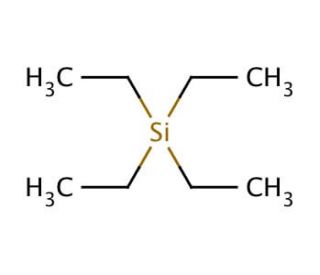

Tetraethylsilane (CAS 631-36-7)
QUICK LINKS
Tetraethylsilane (TES) is a silane compound characterized by a silicon atom bonded to four ethyl groups. Volatile in nature, Tetraethylsilane emits a robust odor reminiscent of ethanol. Widely employed in scientific research, this compound serves as a versatile reagent in organic synthesis with various applications. Tetraethylsilane finds utility in a diverse array of scientific research applications, including organic synthesis, polymer synthesis, and catalysis. Its versatility is exemplified through its frequent use as a reagent in the synthesis of organosilicon compounds and as a catalyst in polymer production. Moreover, Tetraethylsilane acts as a catalyst in the synthesis of diverse organic compounds such as amines, alcohols, and esters. As an organosilicon compound, Tetraethylsilane exhibits the ability to form covalent bonds with other molecules. Additionally, it can engage in hydrogen bonding, rendering it effective as a catalyst in the synthesis of organic compounds. The mechanism of action for Tetraethylsilane involves the generation of a highly reactive intermediate, which subsequently undergoes a series of reactions culminating in the formation of the desired product.
Tetraethylsilane (CAS 631-36-7) References
- Thermal diffusion measurements and simulations of binary mixtures of spherical molecules. | Polyakov, P., et al. 2007. J Chem Phys. 127: 014502. PMID: 17627355
- Fiber optic sensors based on hybrid phenyl-silica xerogel films to detect n-hexane: determination of the isosteric enthalpy of adsorption. | Echeverría, JC., et al. 2017. Beilstein J Nanotechnol. 8: 475-484. PMID: 28326238
- Isolable fluorinated triphenylmethyl cation salts of [HCB11Cl11]-: demonstration of remarkable hydride affinity. | Gunther, SO., et al. 2022. Chem Sci. 13: 4972-4976. PMID: 35655874
- Catalytically Generated Meerwein's Salt-Type Oxonium Ions for Friedel-Crafts C(sp2)-H Methylation with Methanol. | He, T., et al. 2023. J Am Chem Soc. 145: 3795-3801. PMID: 36724501
- Thermal Decomposition Mechanism of Tetraethylsilane by Flash Pyrolysis Vacuum Ultraviolet Photoionization Mass Spectrometry and DFT Calculations: The Competition between β-Hydride Elimination and Bond Homolysis. | Shao, K., et al. 2023. J Phys Chem A. 127: 3966-3975. PMID: 37116096
Ordering Information
| Product Name | Catalog # | UNIT | Price | Qty | FAVORITES | |
Tetraethylsilane, 5 ml | sc-237038 | 5 ml | $42.00 |