
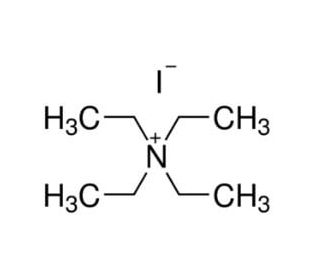

Tetraethylammonium iodide (CAS 68-05-3)
QUICK LINKS
Tetraethylammonium iodide, referred to as TEAI, serves as an organic salt compound of significance in diverse scientific investigations and laboratory tests. It embodies an organic cation attribute, marked by a positive charge bestowed by the presence of four ethyl groups linked to its nitrogen atom. Tetraethylammonium iodide, characterized by its colorless nature and water solubility, stands as a pivotal reagent in the realm of organic synthesis. Tetraethylammonium iodide has assumed a pivotal role in a multitude of scientific inquiries, spanning from the scrutiny of biological systems to the crafting of organic compounds. In the domain of organic compound creation, Tetraethylammonium iodide shines as a vital reagent, contributing to the synthesis of amines and amides. Furthermore, it has proven instrumental in unveiling the biochemical and physiological impacts of diverse compounds like hormones and neurotransmitters. While the precise workings of Tetraethylammonium iodide remain somewhat elusive, indications suggest its interaction with cellular proteins and other molecules. A prevailing notion implicates Tetraethylammonium iodide in the role of an ionophore, thereby potentially facilitating the transfer of ions across cell membranes. This intriguing attribute could potentially enable the conveyance of specific substances, including hormones, into the cellular domain.
Tetraethylammonium iodide (CAS 68-05-3) References
- Speciation of phytate ion in aqueous solution. Alkali metal complex formation in different ionic media. | De Stefano, C., et al. 2003. Anal Bioanal Chem. 376: 1030-40. PMID: 12856098
- [Comparative characteristic of action of tetraethylammonium iodide & its monochlor derivative on the N-cholinoreactive systems]. | BORODKIN, IuS., et al. 1958. Tr Leningr Sanitarnogig Med Inst. 37: 163-70. PMID: 13603640
- Secondary ion emission from solutions: time dependence and surface phenomena. | Kriger, MS., et al. 1992. Anal Chem. 64: 3052-8. PMID: 1463224
- Monitoring the traceability of the pH of a primary tetraborate buffer: comparison of results from primary and secondary apparatus. | Prenesti, E., et al. 2007. Anal Bioanal Chem. 387: 2595-600. PMID: 17245528
- Polarographic determination of malononitrile. | Zollinger, DP., et al. 1984. Talanta. 31: 723-5. PMID: 18963687
- Ionic strength dependence of formation constant-XVI. Protonation of some nitrophenols and dihydroxybenzoic acids in aqueous (tetraethylammonium iodide) solution at 25 degrees. | De Robertis, A. and Sammartano, S. 1993. Talanta. 40: 609-14. PMID: 18965673
- Salt effects on the protonation and on alkali and alkaline earth metal complex formation of 1,2,3-propanetricarboxylate in aqueous solution. | De Stefano, C., et al. 1994. Talanta. 41: 1715-22. PMID: 18966125
- Protonation of carbonate in aqueous tetraalkylammonium salts at 25 degrees C. | Crea, F., et al. 2006. Talanta. 68: 1102-12. PMID: 18970438
- Oxidative properties of iodine-adducts of propylthiouracil and methimazole: direct synthesis of mercury(II) complexes from the reaction with liquid mercury. | Isaia, F., et al. 2011. Dalton Trans. 40: 4505-13. PMID: 21399802
- A Highly Efficient and Reusable Palladium(II)/Cationic 2,2'-Bipyridyl-Catalyzed Stille Coupling in Water. | Wu, WY., et al. 2016. Molecules. 21: PMID: 27617999
- An investigation of the mechanism involved in the cholinergic action of meptazinol. | Hetherington, MS., et al. 1987. J Pharm Pharmacol. 39: 185-9. PMID: 2883282
- The Conversion of 5,5'-Bi(1,2,3-dithiazolylidenes) into Isothiazolo[5,4-d]isothiazoles. | Konstantinova, LS., et al. 2018. Molecules. 23: PMID: 29795048
- The solubility of cholesterol and its exchange between membranes. | Bruckdorfer, KR. and Sherry, MK. 1984. Biochim Biophys Acta. 769: 187-96. PMID: 6691973
- Characterization of a salivary gland-specific esterase in the vector mosquito, Aedes aegypti. | Argentine, JA. and James, AA. 1995. Insect Biochem Mol Biol. 25: 621-30. PMID: 7787844
Ordering Information
| Product Name | Catalog # | UNIT | Price | Qty | FAVORITES | |
Tetraethylammonium iodide, 25 g | sc-251175 | 25 g | $49.00 |