
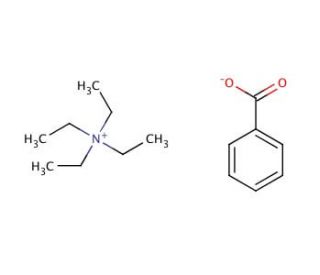

Molecular structure of Tetraethylammonium benzoate, CAS Number: 16909-22-1
Tetraethylammonium benzoate (CAS 16909-22-1)
Alternate Names:
Ethanaminium, N,N,N-triethyl-, benzoate; Tetraethylazanium benzoate
CAS Number:
16909-22-1
Molecular Weight:
251.36
Molecular Formula:
C8H20N•C7H5O2
For Research Use Only. Not Intended for Diagnostic or Therapeutic Use.
* Refer to Certificate of Analysis for lot specific data.
QUICK LINKS
Ordering Information
Description
Technical Information
Safety Information
SDS & Certificate of Analysis
Tetraethylammonium benzoate (TEAB) is an ionic compound that acts as a catalyst for a variety of reactions, including organic syntheses and electrochemical experiments. For example, is used to synthesize heterocycles, polymers, and surfactants, and as an electrolyte in voltammetry and amperometry experiments. Studies have shown that Tetraethylammonium benzoate can cause a decrease in heart rate, blood pressure, and body temperature. It has also been shown to have a mild stimulant effect on the central nervous system.
Tetraethylammonium benzoate (CAS 16909-22-1) References
- New functional degradable and bio-compatible nanoparticles based on poly(malic acid) derivatives for site-specific anti-cancer drug delivery. | Huang, ZW., et al. 2012. Int J Pharm. 423: 84-92. PMID: 21550387
- Preparation of poly(β-L-malic acid)-based charge-conversional nanoconjugates for tumor-specific uptake and cellular delivery. | Zhou, Q., et al. 2015. Int J Nanomedicine. 10: 1941-52. PMID: 25792828
- Size and Charge Dependence of Ion Transport in Human Nail Plate. | Baswan, SM., et al. 2016. J Pharm Sci. 105: 1201-8. PMID: 26886342
- Preparation of Two Types of Polymeric Micelles Based on Poly(β-L-Malic Acid) for Antitumor Drug Delivery. | Yang, T., et al. 2016. PLoS One. 11: e0162607. PMID: 27649562
- Cell Uptake and Biocompatibility of Nanoparticles Prepared from Poly(benzyl malate) (Co)polymers Obtained through Chemical and Enzymatic Polymerization in Human HepaRG Cells and Primary Macrophages. | Casajus, H., et al. 2018. Polymers (Basel). 10: PMID: 30961169
- Synthesis of Poly(Dimethylmalic Acid) Homo- and Copolymers to Produce Biodegradable Nanoparticles for Drug Delivery: Cell Uptake and Biocompatibility Evaluation in Human Heparg Hepatoma Cells. | Khalil, A., et al. 2020. Polymers (Basel). 12: PMID: 32751402
- Effect of the Supporting Electrolyte on Chloroform Reduction at a Silver Electrode in Aqueous Solutions. | Brudzisz, AM., et al. 2021. Molecules. 26: PMID: 33498320
- Synthesis of Poly(Malic Acid) Derivatives End-Functionalized with Peptides and Preparation of Biocompatible Nanoparticles to Target Hepatoma Cells. | Brossard, C., et al. 2021. Nanomaterials (Basel). 11: PMID: 33918663
- Improved Synthesis of a Novel Biodegradable Tunable Micellar Polymer Based on Partially Hydrogenated Poly(β-malic Acid-co-benzyl Malate). | Yu, Z., et al. 2021. Molecules. 26: PMID: 34885750
- Nanoprecipitation of Biocompatible Poly(malic acid) Derivative, Its Ability to Encapsulate a Molecular Photothermal Agent and Photothermal Properties of the Resulting Nanoparticles. | Vargas Guerrero, MG., et al. 2021. Molecules. 26: PMID: 34946784
- Novelty in the development of biodegradable polymer coatings for biomedical devices: paclitaxel grafting on PDMMLA derivatives. | Gholizadeh, E., et al. 2022. Des Monomers Polym. 25: 64-74. PMID: 35341119
- Encapsulation of Hydrophobic Porphyrins into Biocompatible Nanoparticles: An Easy Way to Benefit of Their Two-Photon Phototherapeutic Effect without Hydrophilic Functionalization. | Shi, L., et al. 2022. Cancers (Basel). 14: PMID: 35625963
- Hepatotropic Peptides Grafted onto Maleimide-Decorated Nanoparticles: Preparation, Characterization and In Vitro Uptake by Human HepaRG Hepatoma Cells. | Brossard, C., et al. 2022. Polymers (Basel). 14: PMID: 35746020
Ordering Information
| Product Name | Catalog # | UNIT | Price | Qty | FAVORITES | |
Tetraethylammonium benzoate, 5 g | sc-253666 | 5 g | $214.00 |