
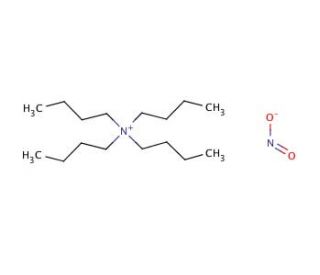

Tetrabutylammonium nitrite (CAS 26501-54-2)
QUICK LINKS
Tetrabutylammonium nitrite is a quaternary ammonium salt that has garnered interest in synthetic organic chemistry due to its role as a phase transfer catalyst. This compound facilitates the migration of a reactant from one phase into another where reaction can take place, making it a valuable asset in multi-phase reaction systems. Its efficacy in enhancing the solubility of polar reactants in non-polar solvents is particularly useful in reactions such as nitrosations or oxidations that require the generation of nitric oxide or other reactive nitrogen species in situ. In the area of green chemistry, tetrabutylammonium nitrite is studied for its potential to minimize the use of hazardous organic solvents, thereby reducing environmental impact. Additionally, research into the use of this compound in ionic liquids provides insights into the development of novel solvent systems with enhanced reactivity and selectivity for a variety of chemical transformations.
Tetrabutylammonium nitrite (CAS 26501-54-2) References
- S-linked ganglioside analogues for use in conjugate vaccines. | Rich, JR. and Bundle, DR. 2004. Org Lett. 6: 897-900. PMID: 15012059
- Efficient synthesis of beta-D-mannosides and beta-D-talosides by double parallel or double serial inversion. | Dong, H., et al. 2007. J Org Chem. 72: 3694-701. PMID: 17439283
- Supramolecular activation in triggered cascade inversion. | Dong, H., et al. 2008. Chem Commun (Camb). 1359-61. PMID: 18389133
- Copper-catalyzed synthesis of esters from ketones. Alkyl group as a leaving group. | Nakatani, Y., et al. 2008. Org Lett. 10: 2067-70. PMID: 18422324
- Supramolecular control in carbohydrate epimerization: discovery of a new anion host-guest system. | Dong, H., et al. 2008. J Am Chem Soc. 130: 15270-1. PMID: 18954047
- Thermodynamic and kinetic studies on reactions of Fe(III)(meso-[tetra(3-sulfonatomesityl)porphin]) with NO in an ionic liquid. Trace impurities can change the mechanism! | Schmeisser, M. and van Eldik, R. 2009. Inorg Chem. 48: 7466-75. PMID: 19537685
- Pd-catalyzed conversion of aryl chlorides, triflates, and nonaflates to nitroaromatics. | Fors, BP. and Buchwald, SL. 2009. J Am Chem Soc. 131: 12898-9. PMID: 19737014
- Expeditious synthesis of bacterial, rare sugar building blocks to access the prokaryotic glycome. | Emmadi, M. and Kulkarni, SS. 2013. Org Biomol Chem. 11: 3098-102. PMID: 23563627
- Easy and direct conversion of tosylates and mesylates into nitroalkanes. | Palmieri, A., et al. 2013. Beilstein J Org Chem. 9: 533-6. PMID: 23616794
- Facile nitrite reduction in a non-heme iron system: formation of an iron(III)-oxo. | Matson, EM., et al. 2014. J Am Chem Soc. 136: 17398-401. PMID: 25470029
- Synthesis of a linker, d(GGAATTCC), through liquid-phase and phosphoroamidate approaches involving deamidation with tetrabutylammonium nitrite-acetic anhydride. | Nishino, S., et al. 1989. Nucleic Acids Symp Ser. 29-30. PMID: 2608467
- A bioinspired iron catalyst for nitrate and perchlorate reduction. | Ford, CL., et al. 2016. Science. 354: 741-743. PMID: 27846604
- 2- O- N-Benzylcarbamoyl as a Protecting Group To Promote β-Selective Glycosylation and Its Applications in the Stereoselective Synthesis of Oligosaccharides. | Lu, YJ., et al. 2018. J Org Chem. 83: 3688-3701. PMID: 29512381
Ordering Information
| Product Name | Catalog # | UNIT | Price | Qty | FAVORITES | |
Tetrabutylammonium nitrite, 10 g | sc-255643 | 10 g | $173.00 |