
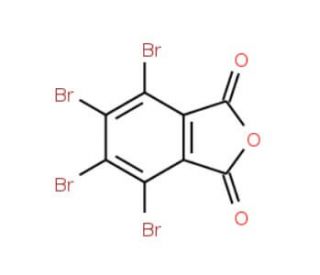

Tetrabromophthalic anhydride (CAS 632-79-1)
QUICK LINKS
Tetrabromophthalic anhydride is a brominated derivative of phthalic anhydride where four hydrogen atoms on the benzene ring are replaced by bromine atoms. This compound is an important reagent in the field of polymer chemistry and is extensively used in the synthesis of flame retardants, which are additives that reduce the flammability of materials. The high bromine content of tetrabromophthalic anhydride makes it particularly effective as a flame retardant. When incorporated into polymers, it works primarily through a free radical mechanism during combustion. The bromine atoms are released as free radicals when the material is heated. These bromine radicals then react with the free radical intermediates in the flame, effectively quenching the chain reactions that sustain the combustion process. This halogenated flame retardant mechanism significantly slows down the spread of fire in materials that contain this compound. In research, tetrabromophthalic anhydride has been used to study the development of new polymeric materials with enhanced fire resistance. It is particularly valuable in creating polyesters and epoxy resins, where it acts as a reactive intermediate that can be polymerized with other monomers. This synthesis process leads to the incorporation of bromine directly into the polymer backbone, enhancing the material′s inherent flame-retardant properties. Furthermore, tetrabromophthalic anhydride is utilized in the synthesis of advanced materials, including high-performance plastics and coatings. Researchers also explore its role in creating modified polymers with specific mechanical and thermal properties, where its presence can influence polymer stability and degradation behavior under high temperatures.
Tetrabromophthalic anhydride (CAS 632-79-1) References
- Carbonic anhydrase activators: amino acyl/dipeptidyl histamine derivatives bind with high affinity to isozymes I, II and IV and act as efficient activators. | Supuran, CT. and Scozzafava, A. 1999. Bioorg Med Chem. 7: 2915-23. PMID: 10658596
- Carbonic anhydrase activators. Part 24. High affinity isozymes I, II and IV activators, derivatives of 4-(4-chlorophenylsulfonylureido-amino acyl)ethyl-1H-imidazole. | Scozzafava, A. and Supuran, CT. 2000. Eur J Pharm Sci. 10: 29-41. PMID: 10699381
- Carbonic anhydrase activators - part 21. Novel activators of isozymes I, II and IV incorporating carboxamido and ureido histamine moieties. | Scozzafava, A. and Supuran, CT. 2000. Eur J Med Chem. 35: 31-9. PMID: 10733601
- Carbonic anhydrase activators: synthesis of high affinity isozymes I, II and IV activators, derivatives of 4-(4-tosylureido-amino acyl)ethyl-1H-imidazole (histamine derivatives). | Scozzafava, A., et al. 2000. J Enzyme Inhib. 15: 139-61. PMID: 10938540
- Carbonic anhydrase activators: synthesis of high affinity isozymes I, II and IV activators, derivatives of 4-(arylsulfonylureido-amino acyl)ethyl-1H-imidazole. | Supuran, CT. and Scozzafava, A. 2000. J Enzyme Inhib. 15: 471-86. PMID: 11030087
- Analysis of Ah receptor pathway activation by brominated flame retardants. | Brown, DJ., et al. 2004. Chemosphere. 55: 1509-18. PMID: 15099731
- Spectrochemical and thermal analysis of Al-tetrabromophthalate and tetrabromophthalic anhydride. A comparison of methods for determination of aluminium. | Paama, L., et al. 1997. Talanta. 45: 35-8. PMID: 18966978
- Optimization and development of analytical methods for the determination of new brominated flame retardants and polybrominated diphenyl ethers in sediments and suspended particulate matter. | López, P., et al. 2011. Anal Bioanal Chem. 400: 871-83. PMID: 21369755
- The Simultaneous Determination of Six Flame Retardants in Water Samples Using SPE Pre-concentration and UHPLC-UV Method. | Kowalski, B. and Mazur, M. 2014. Water Air Soil Pollut. 225: 1866. PMID: 24672141
- Quantitative Metabolite Profiling of an Amino Group Containing Pharmaceutical in Human Plasma via Precolumn Derivatization and High-Performance Liquid Chromatography-Inductively Coupled Plasma Mass Spectrometry. | Li, S., et al. 2017. Anal Chem. 89: 1907-1915. PMID: 28050907
Ordering Information
| Product Name | Catalog # | UNIT | Price | Qty | FAVORITES | |
Tetrabromophthalic anhydride, 100 g | sc-272560 | 100 g | $49.00 |