
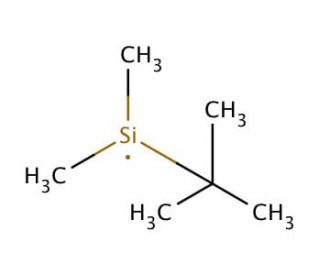

Molecular structure of tert-Butyldimethylsilane, CAS Number: 29681-57-0
tert-Butyldimethylsilane (CAS 29681-57-0)
CAS Number:
29681-57-0
Molecular Weight:
116.28
Molecular Formula:
C6H16Si
Supplemental Information:
This is classified as a Dangerous Good for transport and may be subject to additional shipping charges.
For Research Use Only. Not Intended for Diagnostic or Therapeutic Use.
* Refer to Certificate of Analysis for lot specific data.
QUICK LINKS
Ordering Information
Description
Technical Information
Safety Information
SDS & Certificate of Analysis
tert-Butyldimethylsilane serves as a silylating agent in organic synthesis. It finds utility as a protective group for alcohols and carboxylic acids, enabling selective transformations. Additionally, tert-Butyldimethylsilane plays a role in the synthesis of amines, esters, and diverse compounds. Its significance extends to the realm of biopolymers, as it contributes to the synthesis of peptides, oligonucleotides, and other biomolecules. Moreover, tert-Butyldimethylsilane finds application in the synthesis of natural products, including terpenes and alkaloids,
tert-Butyldimethylsilane (CAS 29681-57-0) References
- Regioselective silylation of sugars through palladium nanoparticle-catalyzed silane alcoholysis. | Chung, MK., et al. 2002. J Am Chem Soc. 124: 10508-18. PMID: 12197753
- Regioselectively trisilylated hexopyranosides through homogeneously catalyzed silane alcoholysis. | Chung, MK. and Schlaf, M. 2005. J Am Chem Soc. 127: 18085-92. PMID: 16366560
- Iron-promoted free radical cascade difunctionalization of unsaturated benzamides with silanes. | Ge, Y., et al. 2020. Chem Commun (Camb). 56: 12656-12659. PMID: 32966391
- A fluorescent probe for the discrimination of oxidation states of palladium. | Jiang, L., et al. 2021. Chem Sci. 12: 9977-9982. PMID: 34349968
- Light-Mediated Defluorosilylation of α-Trifluoromethyl Arylalkenes through Hydrogen Atom Transfer. | Yue, F., et al. 2022. Org Lett. 24: 4019-4023. PMID: 35611872
- Rhodium (II) perfluorobutyrate catalyzed silane alcoholysis. A highly selective route to silyl ethers | Doyle, M. P., High, K. G., Bagheri, V., Pieters, R. J., Lewis, P. J., & Pearson, M. M. 1990. The Journal of Organic Chemistry. 55(25): 6082-6086.
- Determination of the molecular structure of tert-butyldimethylsilane in the gas phase by electron diffraction | Forsyth, G. A., Rankin, D. W., & Robertson, H. E. 1991. Journal of molecular structure. 263: 311-317.
- Silylcarbobicyclization of 1,6-Diynes: A Novel Catalytic Route to Bicyclo[3.3.0]octenones | Iwao Ojima, Dora A. Fracchiolla, Robert J. Donovan, and Pratip Banerji. 1994. J. Org. Chem. 59(25): 7594–7595.
- Transition-metal complex-catalyzed reduction of amides with hydrosilanes: a facile transformation of amides to amines | Igarashi, M., & Fuchikami, T. 2001. Tetrahedron Letters. 42(10): 1945-1947.
- Undesirable deprotection of O-TBDMS groups by Pd/C-catalyzed hydrogenation and chemoselective hydrogenation using a Pd/C (en) catalyst | Hattori, K., Sajiki, H., & Hirota, K. 2001. Tetrahedron. 57(11): 2109-2114.
- Experimental evidence and bond characterization of a cyclopropenylgermylene | Tsutsui, S., Tanaka, H., Kwon, E., Matsumoto, S., & Sakamoto, K. 2006. Journal of organometallic chemistry. 691(4): 595-603.
- Azoaniline-based rapid and selective dual sensor for copper and fluoride ions with two distinct output modes of detection | Gupta, M., Balamurugan, A., & Lee, H. I. 2015. Sensors and Actuators B: Chemical. 211: 531-536.
- Oxidation of Triorganosilanes and Related Compounds by Chlorine Dioxide | S. A. Grabovskiy & N. N. Kabal'nova and. 2021. Russian Journal of General Chemistry. 91: 2391–2402.
Ordering Information
| Product Name | Catalog # | UNIT | Price | Qty | FAVORITES | |
tert-Butyldimethylsilane, 5 g | sc-251140 | 5 g | $107.00 |