
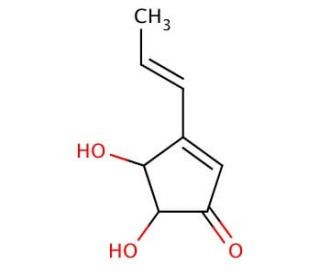

Terrein (CAS 582-46-7)
QUICK LINKS
Terrein is an intriguing organic compound initially isolated from the fungus *Aspergillus terreus*. This small molecule is characterized by its unique chemical structure that includes a furan ring fused to a lactone ring, along with an exocyclic double bond, conferring to it distinctive chemical properties and reactivity. In the realm of research, terrein has been extensively studied for its diverse biological activities, which include anti-inflammatory and anti-oxidative properties. However, focusing on its non-medical applications, terrein has shown potential in agricultural research, particularly as an elicitor of plant defenses against pathogens. Its application in biotechnology is also noteworthy; terrein can induce specific stress responses in plants, leading to the activation of their secondary metabolic pathways. This mechanism is valuable for enhancing the production of natural plant products like phytoalexins, which are crucial for plant defense mechanisms. Moreover, terrein′s role in chemical ecology involves mediating interactions between fungi and their environment, offering insights into fungal competition and survival strategies. In the field of natural product chemistry, terrein serves as a model compound for synthetic modifications, helping chemists design and synthesize novel compounds with potentially useful properties.
Terrein (CAS 582-46-7) References
- Terrein: a new melanogenesis inhibitor and its mechanism. | Park, SH., et al. 2004. Cell Mol Life Sci. 61: 2878-85. PMID: 15558216
- Terrein biosynthesis in Aspergillus terreus and its impact on phytotoxicity. | Zaehle, C., et al. 2014. Chem Biol. 21: 719-31. PMID: 24816227
- Terrein reduces age-related inflammation induced by oxidative stress through Nrf2/ERK1/2/HO-1 signalling in aged HDF cells. | Lee, YH., et al. 2015. Cell Biochem Funct. 33: 479-86. PMID: 26416516
- Terrein suppressed lipopolysaccharide-induced neuroinflammation through inhibition of NF-κB pathway by activating Nrf2/HO-1 signaling in BV2 and primary microglial cells. | Kim, KW., et al. 2020. J Pharmacol Sci. 143: 209-218. PMID: 32414692
- Inhibitory effects of terrein on lung cancer cell metastasis and angiogenesis. | Buachan, P., et al. 2021. Oncol Rep. 45: PMID: 33846818
- Recent Advances in Isolation, Synthesis and Biological Evaluation of Terrein. | Huang, D., et al. 2021. Chem Biodivers. 18: e2100594. PMID: 34704347
- Enhanced production of terrein in marine-derived Aspergillus terreus by refactoring both global and pathway-specific transcription factors. | Yao, G., et al. 2022. Microb Cell Fact. 21: 136. PMID: 35794562
- Protection against Lipopolysaccharide-Induced Endotoxemia by Terrein Is Mediated by Blocking Interleukin-1β and Interleukin-6 Production. | Yoon, YD., et al. 2022. Pharmaceuticals (Basel). 15: PMID: 36422559
- The Fungal Metabolite (+)-Terrein Abrogates Inflammatory Bone Resorption via the Suppression of TNF-α Production in a Ligature-Induced Periodontitis Mouse Model. | Sako, H., et al. 2023. J Fungi (Basel). 9: PMID: 36983482
- Phytotoxic and Antimicrobial Terrein Derivatives and Butenolides Isolated from the Endophytic Fungus Aspergillus terreus HT5. | Wang, W., et al. 2023. J Agric Food Chem. 71: 20713-20723. PMID: 38095326
Ordering Information
| Product Name | Catalog # | UNIT | Price | Qty | FAVORITES | |
Terrein, 1 mg | sc-364142 | 1 mg | $133.00 | |||
Terrein, 5 mg | sc-364142A | 5 mg | $437.00 |