
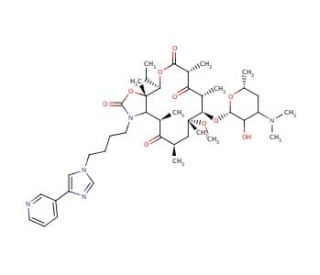

Telithromycin (CAS 191114-48-4)
See product citations (2)
QUICK LINKS
Telithromycin, identified by CAS number 191114-48-4, is a synthetic derivative of the macrolide antibiotic erythromycin, and it belongs to a class of compounds known as ketolides. Specifically engineered for research purposes, Telithromycin is primarily used to study bacterial protein synthesis and the mechanisms through which bacteria can develop resistance to macrolide inhibitors. The mechanism of action of Telithromycin involves binding to the 50S subunit of the bacterial ribosome, a critical component in the protein synthesis machinery of bacteria. Unlike traditional macrolides, Telithromycin binds at two distinct sites on the ribosome, which enhances its binding efficiency and helps overcome resistance mechanisms that typically affect other macrolides. By binding to the ribosome, Telithromycin inhibits the translocation step of protein synthesis, which is the movement of tRNA and mRNA through the ribosome, effectively halting the growth and multiplication of bacteria. This dual binding characteristic makes Telithromycin a valuable tool in microbiological research, particularly in studying how modifications in ribosomal binding sites contribute to antibiotic resistance. Research involving Telithromycin has helped explain the structural and functional dynamics of ribosomal interactions and has provided deeper insights into the adaptive mechanisms employed by bacteria when exposed to ribosomal inhibitors.
Telithromycin (CAS 191114-48-4) References
- Telithromycin is active against Mycobacterium avium in mice despite lacking significant activity in standard in vitro and macrophage assays and is associated with low frequency of resistance during treatment. | Bermudez, LE., et al. 2001. Antimicrob Agents Chemother. 45: 2210-4. PMID: 11451676
- Activities of new macrolides and fluoroquinolones against Mycobacterium ulcerans infection in mice. | Bentoucha, A., et al. 2001. Antimicrob Agents Chemother. 45: 3109-12. PMID: 11600364
- Treatment of acute Chlamydia pneumoniae infection with telithromycin in C57BL/6J mice. | Törmäkangas, L., et al. 2004. J Antimicrob Chemother. 53: 1101-4. PMID: 15117927
- Efficacy of telithromycin in the treatment of experimental Bacteroides fragilis intraabdominal abscess in the senescent mice. | Thadepalli, H., et al. 2004. Infez Med. 12: 44-50. PMID: 15329528
- Telithromycin treatment of chronic Chlamydia pneumoniae infection in C57BL/6J mice. | Törmäkangas, L., et al. 2004. Antimicrob Agents Chemother. 48: 3655-61. PMID: 15388416
- Pharmacodynamic profile of telithromycin against macrolide- and fluoroquinolone-resistant Streptococcus pneumoniae in a neutropenic mouse thigh model. | Tessier, PR., et al. 2005. Antimicrob Agents Chemother. 49: 188-94. PMID: 15616295
- Telithromycin inhibits the production of proinflammatory mediators and the activation of NF-kappaB in in vitro-stimulated murine cells. | Leiva, M., et al. 2008. FEMS Immunol Med Microbiol. 53: 343-50. PMID: 18557935
Ordering Information
| Product Name | Catalog # | UNIT | Price | Qty | FAVORITES | |
Telithromycin, 1 mg | sc-212994 | 1 mg | $213.00 | |||
Telithromycin, 25 mg | sc-212994A | 25 mg | $515.00 |