
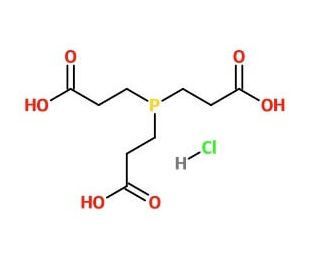

TCEP, Hydrochloride (CAS 51805-45-9)
See product citations (13)
QUICK LINKS
TCEP, Hydrochloride is a water soluble, non-thiol, strong reducing agent shown to cleave disulfide bonds. Reports indicate that TCEP, Hydrochloride can rapidly reduce stable alkyl disulfides, including DTT. TCEP, Hydrochloride has been observed to reduce DHA in a solution of EDTA and metaphosphoric acid. TCEP, Hydrochloride is also used to conduct proteolysis and Hydrogen/Deuterium exchange. Binding studies demonstrate that TCEP, Hydrochloride does not bind Hg2+, and its binding efficacy to NF-κB-DNA has been tested in vitro. TCEP, Hydrochloride is also known as tris(2-Carboxyethyl)phosphine HCl, 3,3,3-Phosphinidynetrispropanoic Acid Hydrochloride, 3-bis(3-oxido-3-oxopropyl)phosphanylpropanoate, and propanoic acid, 3, 3′, 3′ ′ -phosphinidynetris-, hydrochloride.
TCEP, Hydrochloride (CAS 51805-45-9) References
- Inhibition of NF-kappaB-DNA binding by mercuric ion: utility of the non-thiol reductant, tris(2-carboxyethyl)phosphine hydrochloride (TCEP), on detection of impaired NF-kappaB-DNA binding by thiol-directed agents. | Dieguez-Acuña, FJ. and Woods, JS. 2000. Toxicol In Vitro. 14: 7-16. PMID: 10699356
- Determination of ascorbic acid and dehydroascorbic acid in biological samples by high-performance liquid chromatography using subtraction methods: reliable reduction with tris[2-carboxyethyl]phosphine hydrochloride. | Lykkesfeldt, J. 2000. Anal Biochem. 282: 89-93. PMID: 10860503
- Switch peptide via Staudinger reaction. | Nepomniaschiy, N., et al. 2008. Org Lett. 10: 5243-6. PMID: 18959426
- TCEP treatment reduces proteolytic activity of BoNT/B in human neuronal SHSY-5Y cells. | Shi, X., et al. 2009. J Cell Biochem. 107: 1021-30. PMID: 19492407
- Simultaneous reduction and digestion of proteins with disulfide bonds for hydrogen/deuterium exchange monitored by mass spectrometry. | Zhang, HM., et al. 2010. Anal Chem. 82: 1450-4. PMID: 20099838
- Determination of dehydroascorbic acid in mouse tissues and plasma by using tris(2-carboxyethyl)phosphine hydrochloride as reductant in metaphosphoric acid/ethylenediaminetetraacetic acid solution. | Sato, Y., et al. 2010. Biol Pharm Bull. 33: 364-9. PMID: 20190394
- Excystation of Eimeria acervulina, E. maxima, and E. tenella differs in response to trypsin and chymotrypsin and the presence of reducing agents DTT and TCEP. | Jenkins, MC., et al. 2019. Mol Biochem Parasitol. 233: 111219. PMID: 31518610
- Effects of Small Molecules on DNA Adsorption by Gold Nanoparticles and a Case Study of Tris(2-carboxyethyl)phosphine (TCEP). | Wu, R., et al. 2019. Langmuir. 35: 13461-13468. PMID: 31536371
- Effects of tris (2-carboxyethyl) phosphine hydrochloride treatment on porcine oocyte in vitro maturation and subsequent in vitro fertilized embryo developmental capacity. | Zeng, Y., et al. 2021. Theriogenology. 162: 32-41. PMID: 33444914
- In-capillary (electrophoretic) digestion-reduction-separation: A smart tool for middle-up analysis of mAb. | Dadouch, M., et al. 2021. J Chromatogr A. 1648: 462213. PMID: 33991752
- Nitric oxide inhibits endothelial cell apoptosis by inhibiting cysteine-dependent SOD1 monomerization. | Peng, H., et al. 2022. FEBS Open Bio. 12: 538-548. PMID: 34986524
- Ultrasensitive disulfide scrambling analysis of mAbs by LC-MS with post-column reduction and glycine signal enhancement. | Kleinberg, A., et al. 2022. Anal Biochem. 653: 114773. PMID: 35688259
- Thiol Catalysis of Selenosulfide Bond Cleavage by a Triarylphosphine. | Firstova, O., et al. 2022. J Org Chem. 87: 9426-9430. PMID: 35763672
- A procedure for quantitative determination of tris(2-carboxyethyl)phosphine, an odorless reducing agent more stable and effective than dithiothreitol. | Han, JC. and Han, GY. 1994. Anal Biochem. 220: 5-10. PMID: 7978256
- Solubilization of hydrophobic peptides by reversible cysteine PEGylation. | Pomroy, NC. and Deber, CM. 1998. Biochem Biophys Res Commun. 245: 618-21. PMID: 9571204
Ordering Information
| Product Name | Catalog # | UNIT | Price | Qty | FAVORITES | |
TCEP, Hydrochloride, 1 g | sc-203290 | 1 g | $88.00 | |||
TCEP, Hydrochloride, 25 g | sc-203290A | 25 g | $832.00 |