
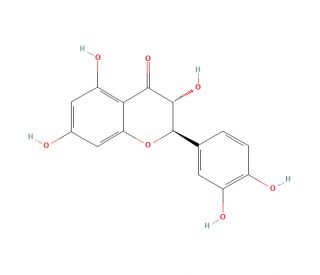

(+)-Taxifolin (CAS 17654-26-1)
QUICK LINKS
(+)-Taxifolin is a flavanone compound which modulates chemopreventive genes through activation of the ARE. Studies show that (+)-Taxifolin up-regulates 65 genes including, NQO1, GSTM1, TXNRD1 and down-regulates 363 genes. In addition, (+)-Taxifolin can impede the influx of calcium required to up-regulate the expression of Mac-1-dependent neutrophil firm adhesion resulting in an anti-imflammatory effect. Alternately (+)-Taxifolin can inhibit ROS production by suppressing fMLP and PMA or by impairing the activation of NADPH (sc-202725). Furthermore, (+)-Taxifolin suppresses the secretion of apoB (apolipoprotein B) and increases the secretion of apoA-I (apolipoprotein A-I), which modulate hepatic lipid synthesis.
(+)-Taxifolin (CAS 17654-26-1) References
- Modulation of hepatic lipoprotein synthesis and secretion by taxifolin, a plant flavonoid. | Theriault, A., et al. 2000. J Lipid Res. 41: 1969-79. PMID: 11108730
- Prevention of macrophage adhesion molecule-1 (Mac-1)-dependent neutrophil firm adhesion by taxifolin through impairment of protein kinase-dependent NADPH oxidase activation and antagonism of G protein-mediated calcium influx. | Wang, YH., et al. 2004. Biochem Pharmacol. 67: 2251-62. PMID: 15163556
- In vitro effects of myricetin, morin, apigenin, (+)-taxifolin, (+)-catechin, (-)-epicatechin, naringenin and naringin on cytochrome b5 reduction by purified NADH-cytochrome b5 reductase. | Çelik, H., et al. 2013. Toxicology. 308: 34-40. PMID: 23567315
- Structure-activity relationship for (+)-taxifolin isolated from silymarin as an inhibitor of amyloid β aggregation. | Sato, M., et al. 2013. Biosci Biotechnol Biochem. 77: 1100-3. PMID: 23649236
- Enzymatic activity of cell-free extracts from Burkholderia oxyphila OX-01 bio-converts (+)-catechin and (-)-epicatechin to (+)-taxifolin. | Otsuka, Y., et al. 2016. Biosci Biotechnol Biochem. 80: 2473-2479. PMID: 27685324
- The mechanism of (+) taxifolin's protective antioxidant effect for •OH-treated bone marrow-derived mesenchymal stem cells. | Li, X., et al. 2017. Cell Mol Biol Lett. 22: 31. PMID: 29299033
- Computational Study of the Aza-Michael Addition of the Flavonoid (+)-Taxifolin in the Inhibition of β-Amyloid Fibril Aggregation. | Ginex, T., et al. 2018. Chemistry. 24: 5813-5824. PMID: 29384229
- Cardioprotective Effect of Taxifolin against Isoproterenol-Induced Cardiac Injury through Decreasing Oxidative Stress, Inflammation, and Cell Death, and Activating Nrf2/HO-1 in Mice. | Obeidat, HM., et al. 2022. Biomolecules. 12: PMID: 36358896
- Structural Basis for (2R,3R)-Taxifolin Binding and Reaction Products to the Bacterial Chalcone Isomerase of Eubacterium ramulus. | Palm, GJ., et al. 2022. Molecules. 27: PMID: 36432010
- Paclitaxel and carboplatin in the treatment of advanced non-small cell lung cancer. | Langer, CJ., et al. 1995. Semin Oncol. 22: 64-9. PMID: 7541156
Ordering Information
| Product Name | Catalog # | UNIT | Price | Qty | FAVORITES | |
(+)-Taxifolin, 10 mg | sc-202829 | 10 mg | $38.00 | |||
(+)-Taxifolin, 50 mg | sc-202829A | 50 mg | $130.00 |