
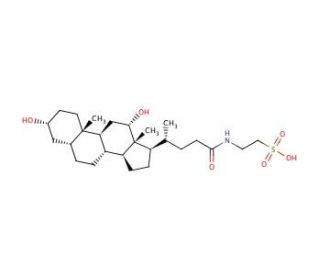

Taurodeoxychloic acid (CAS 516-50-7)
QUICK LINKS
Taurodeoxycholic acid is frequently used in research focused on the study of bile acids and their physiological and biochemical roles, particularly in the digestion and absorption of lipids and fat-soluble vitamins. It is of interest in the investigation of the enterohepatic circulation of bile acids, as well as their regulatory effects on bile acid synthesis. In biochemical assays, Taurodeoxycholic acid is used to examine the function of bile salt transporters and the mechanism of micelle formation. Additionally, it is employed in studies looking at the modulation of cholesterol metabolism and the solubilization of membrane proteins. Research on Taurodeoxycholic acid also includes its role in the gut microbiome, where it can influence the composition and behavior of intestinal bacteria.
Taurodeoxychloic acid (CAS 516-50-7) References
- Transactivation of the epidermal growth factor receptor mediates cholinergic agonist-induced proliferation of H508 human colon cancer cells. | Cheng, K., et al. 2003. Cancer Res. 63: 6744-50. PMID: 14583469
- Taurodeoxycholate increases intestinal epithelial cell proliferation through c-myc expression. | Yamaguchi, J., et al. 2004. Surgery. 135: 215-21. PMID: 14739857
- Taurodeoxycholate stimulates intestinal cell proliferation and protects against apoptotic cell death through activation of NF-kappaB. | Toledo, A., et al. 2004. Dig Dis Sci. 49: 1664-71. PMID: 15573924
- Bile acid-induced proliferation of a human colon cancer cell line is mediated by transactivation of epidermal growth factor receptors. | Cheng, K. and Raufman, JP. 2005. Biochem Pharmacol. 70: 1035-47. PMID: 16139803
- Phosphorylation of beta-catenin by AKT promotes beta-catenin transcriptional activity. | Fang, D., et al. 2007. J Biol Chem. 282: 11221-9. PMID: 17287208
- Taurocholate and taurodeoxycholate: gel formation and protonation constants. | Antonilli, M., et al. 2007. Ann Chim. 97: 39-48. PMID: 17822262
- A polyamine analog bismethylspermine ameliorates severe pancreatitis induced by intraductal infusion of taurodeoxycholate. | Jin, HT., et al. 2008. Surgery. 144: 49-56. PMID: 18571584
- Taurodeoxycholate-induced intestinal injury is modulated by oxidative stress-dependent pre-conditioning like mechanisms. | Portincasa, P., et al. 2008. Toxicol Lett. 182: 36-41. PMID: 18771718
- Eimeria tenella: incomplete excystation in the presence of EDTA in a taurodeoxycholate-based medium. | Dulski, PM. 1990. J Protozool. 37: 524-8. PMID: 2128338
- Taurodeoxycholate Increases the Number of Myeloid-Derived Suppressor Cells That Ameliorate Sepsis in Mice. | Chang, S., et al. 2018. Front Immunol. 9: 1984. PMID: 30279688
- Evaluation of acute and subacute toxicity of sodium taurodeoxycholate in rats. | Choi, HJ., et al. 2021. Drug Chem Toxicol. 44: 268-276. PMID: 31215257
- A Network Pharmacology to Explore the Mechanism of Calculus Bovis in the Treatment of Ischemic Stroke. | Liu, F., et al. 2021. Biomed Res Int. 2021: 6611018. PMID: 33778069
- Taurodeoxycholate and the developing rabbit distal colon: absence of secretory effect. | Potter, GD., et al. 1987. Am J Physiol. 253: G483-8. PMID: 3477961
- Effect of taurodeoxycholate, colipase and temperature on the interfacial inactivation of porcine pancreatic lipase. | Granon, S. and Sémériva, M. 1980. Eur J Biochem. 111: 117-24. PMID: 7439178
- A taurodeoxycholate-activated galactosylceramidase in the murine intestine. | Kobayashi, T. and Suzuki, K. 1981. J Biol Chem. 256: 1133-7. PMID: 7451495
- Taurodeoxycholate activates potassium and chloride conductances via an IP3-mediated release of calcium from intracellular stores in a colonic cell line (T84). | Devor, DC., et al. 1993. J Clin Invest. 92: 2173-81. PMID: 7693758
- Nucleotide-binding properties of kinase-deficient epidermal-growth-factor-receptor mutants. | Cheng, K. and Koland, JG. 1998. Biochem J. 330 (Pt 1): 353-9. PMID: 9461530
Ordering Information
| Product Name | Catalog # | UNIT | Price | Qty | FAVORITES | |
Taurodeoxychloic acid, 10 mg | sc-212991 | 10 mg | $478.00 |