
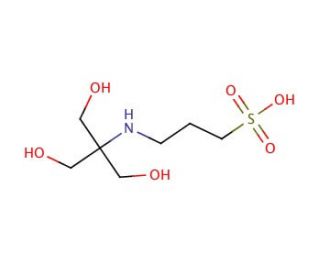

Molecular structure of TAPS, CAS Number: 29915-38-6
TAPS (CAS 29915-38-6)
Alternate Names:
N-[Tris(hydroxymethyl)methyl]-3-aminopropanesulfonic acid
Application:
TAPS is a zwitterionic buffer that has a useful pH range of 7.7 - 9.1
CAS Number:
29915-38-6
Purity:
≥99%
Molecular Weight:
243.2
Molecular Formula:
C7H17NO6S
For Research Use Only. Not Intended for Diagnostic or Therapeutic Use.
* Refer to Certificate of Analysis for lot specific data.
QUICK LINKS
Ordering Information
Description
Technical Information
Safety Information
SDS & Certificate of Analysis
TAPS is a zwitterionic buffer used in biochemistry and molecular biology. It has a useful pH range of 7.7 - 9.1. TAPS has been utilized in capillary electrophoresis of such materials as DNA and DNA-dye complexes. Dyes have been separated by planar chromatography with electroosmotic flow with 1 mM TAPS in the mobile phase. The stability constants of metal ions with TAPS have been investigated by capillary electrophoresis. TAPS has also been shown to inhibit connexin channel activity. The activity of various mutants of carbonic anhydrase I and carbonic anhydrase II has been studied in a variety of buffers, including TAPS. Physiological buffer, pKa = 8.4 at 20 deg C.
TAPS (CAS 29915-38-6) References
- Improvements in DNA sequencing by capillary electrophoresis at elevated temperature using poly(ethylene oxide) as a sieving matrix. | Wei, W. and Yeung, ES. 2000. J Chromatogr B Biomed Sci Appl. 745: 221-30. PMID: 10997717
- Separation using planar chromatography with electroosmotic flow. | Nurok, D., et al. 2000. J Chromatogr A. 903: 211-7. PMID: 11153944
- Comparison of sieving matrices for on-the-fly fluorescence lifetime detection of dye-labeled DNA fragments. | Li, L. and McGown, LB. 2001. Fresenius J Anal Chem. 369: 267-72. PMID: 11293703
- Effect of glycerol-induced DNA conformational change on the separation of DNA fragments by capillary electrophoresis. | Liang, D., et al. 2001. J Chromatogr A. 931: 163-73. PMID: 11695518
- Capillary electrophoretic study of interactions of metal ions with crown ethers, a sulfated beta-cyclodextrin, and zwitterionic buffers present as additives in the background electrolyte. | Muzikár, M., et al. 2002. Electrophoresis. 23: 1796-802. PMID: 12116122
- Proton transfer roles of lysine 64 and glutamic acid 64 replacing histidine 64 in the active site of human carbonic anhydrase II. | Engstrand, C., et al. 1992. Biochim Biophys Acta. 1122: 321-6. PMID: 1354487
- Buffer dependence of CO2 hydration catalyzed by human carbonic anhydrase I. | Ren, X. and Lindskog, S. 1992. Biochim Biophys Acta. 1120: 81-6. PMID: 1554744
- Role of histidine 64 in the catalytic mechanism of human carbonic anhydrase II studied with a site-specific mutant. | Tu, CK., et al. 1989. Biochemistry. 28: 7913-8. PMID: 2514797
- Buffers for enzymes. | Blanchard, JS. 1984. Methods Enzymol. 104: 404-14. PMID: 6717292
- Improved stability and electrophoretic properties of preformed fluorescent cationic dye-DNA complexes in a taps-tetrapentylammonium buffer in agarose slab gels. | Zeng, Z., et al. 1997. Anal Biochem. 252: 110-4. PMID: 9324948
- Regulation of connexin channels by pH. Direct action of the protonated form of taurine and other aminosulfonates. | Bevans, CG. and Harris, AL. 1999. J Biol Chem. 274: 3711-9. PMID: 9920923
Inhibitor of:
Myosin IXa.Ordering Information
| Product Name | Catalog # | UNIT | Price | Qty | FAVORITES | |
TAPS, 100 g | sc-216101 | 100 g | $68.00 | |||
TAPS, 1 kg | sc-216101A | 1 kg | $450.00 |