
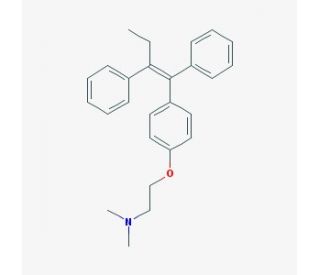

Tamoxifen (CAS 10540-29-1)
See product citations (18)
QUICK LINKS
Tamoxifen serves as a selective estrogen response modifier (SERM), providing a nuanced mechanism to modulate estrogen receptor activity. Its role extends into inhibiting protein kinase C (PKC), a pivotal enzyme in cell signaling pathways that influence cell growth and differentiation, showcasing its potential in research focused on cellular regulation and signal transduction. Moreover, tamoxifen exhibits anti-angiogenic properties, hindering the development of new blood vessels, which is in studying tumor growth and metastasis. Through metabolic transformation by cytochrome P450 isoforms CYP2D6 and CYP3A4, tamoxifen is converted into its active metabolites, 4-hydroxytamoxifen (4-OHT) and endoxifen, which are central to its mechanism of action. This transformation underscores the importance of metabolic pathways in modulating the activity of compounds. In the context of breast cancer research, tamoxifen′s ability to act as a gene repressor against ERBB2 through PAX2 dependency highlights its potential in gene expression studies and the exploration of genetic regulatory mechanisms. Its efficacy in blocking estradiol-stimulated VEGF production in breast tumor cells further emphasizes its role in dissecting hormone-driven processes in oncogenesis. Additionally, tamoxifen′s induction of apoptosis in human malignant glioma cell lines presents a model for investigating programmed cell death mechanisms. As an activator of both estrogen receptor alpha (ER alpha) and beta (ER beta), tamoxifen facilitates the exploration of estrogen receptor signaling pathways, contributing significantly to the broader understanding of cellular responses to hormonal stimulation.
Tamoxifen (CAS 10540-29-1) References
- A molecular modeling study of the interactions between the antiestrogen drug tamoxifen and several derivatives, and the calcium-binding protein calmodulin. | Edwards, KJ., et al. 1992. J Med Chem. 35: 2753-61. PMID: 1322985
- TGFbeta2 and TbetaRII are valid molecular biomarkers for the antiproliferative effects of tamoxifen and tamoxifen metabolites in breast cancer cells. | Buck, MB., et al. 2008. Breast Cancer Res Treat. 107: 15-24. PMID: 18043895
- Amino and iodotamoxifens: synthesis, estrogen receptor affinity and biodistribution. | Strickland, LA., et al. 1990. Drug Des Deliv. 6: 195-212. PMID: 1963782
- Tamoxifen metabolite isomer separation and quantification by liquid chromatography-tandem mass spectrometry. | Jaremko, M., et al. 2010. Anal Chem. 82: 10186-93. PMID: 21086978
- Oxidative Heck arylation for the stereoselective synthesis of tetrasubstituted olefins using nitroxides as oxidants. | He, Z., et al. 2012. Angew Chem Int Ed Engl. 51: 3699-702. PMID: 22383123
- Opposite effects of tamoxifen on in vitro protein kinase C activity and endogenous protein phosphorylation in intact MCF-7 cells. | Issandou, M., et al. 1990. Cancer Res. 50: 5845-50. PMID: 2393853
- Stereoselective synthesis of triarylethylenes via copper-palladium catalyzed decarboxylative cross-coupling: synthesis of (Z)-tamoxifen. | Cahiez, G., et al. 2014. Chem Commun (Camb). 50: 8982-4. PMID: 24980393
- Synthesis and biological evaluation of novel tamoxifen-1,2,4-triazole conjugates. | Murty, MS., et al. 2016. Mol Divers. 20: 687-703. PMID: 27278444
- Tamoxifen Isomers and Metabolites Exhibit Distinct Affinity and Activity at Cannabinoid Receptors: Potential Scaffold for Drug Development. | Ford, BM., et al. 2016. PLoS One. 11: e0167240. PMID: 27936172
- Tamoxifen a pioneering drug: An update on the therapeutic potential of tamoxifen derivatives. | Shagufta,. and Ahmad, I. 2018. Eur J Med Chem. 143: 515-531. PMID: 29207335
- Inhibition of protein kinase C by tamoxifen. | O'Brian, CA., et al. 1985. Cancer Res. 45: 2462-5. PMID: 3157445
- Aspects of metabolism of tamoxifen by rat liver microsomes. Identification of a new metabolite: E-1-[4-(2-dimethylaminoethoxy)-phenyl]-1, 2-diphenyl-1-buten-3-ol N-oxide. | McCague, R. and Seago, A. 1986. Biochem Pharmacol. 35: 827-34. PMID: 3954788
- Pharmacology of tamoxifen in laboratory animals. | Jordan, VC., et al. 1980. Cancer Treat Rep. 64: 745-59. PMID: 6775807
- Determination of pharmaceuticals and related impurities by capillary electrophoresis. | Ng, CL., et al. 1994. J Chromatogr A. 680: 579-86. PMID: 7981835
- The antioxidant action of a pure antioestrogen: ability to inhibit lipid peroxidation compared to tamoxifen and 17 beta-oestradiol and relevance to its anticancer potential. | Wiseman, H. 1994. Biochem Pharmacol. 47: 493-8. PMID: 8117317
Ordering Information
| Product Name | Catalog # | UNIT | Price | Qty | FAVORITES | |
Tamoxifen, 2.5 g | sc-208414 | 2.5 g | $272.00 |