
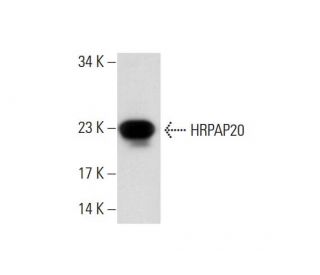


T-47D Cell Lysate: sc-2293
- 500 µg protein in 200 µl SDS-PAGE Western blotting buffer
- human whole cell lysate; breast duct carcinoma cells
- whole cell lysate provided as Western blotting positive control
- should be stored at -20°C and repeated freezing and thawing should be minimized
- sample vial should be placed at 95° C for up to 5 minutes, once prior to use

QUICK LINKS
SEE ALSO...
T-47D Cell Lysate is derived from T-47D cells, a human breast cancer cell line established from the pleural effusion of a 54-year-old female patient with infiltrating ductal breast carcinoma. This lysate is extensively used in cancer research to investigate the molecular mechanisms underlying breast cancer progression and hormone responsiveness. T-47D cells are estrogen receptor (ER) and progesterone receptor (PR) positive, making the lysate valuable for studying hormone signaling pathways and their impact on tumor growth and survival. Researchers utilize T-47D Cell Lysate to analyze the expression, phosphorylation, and interactions of key proteins involved in signaling pathways such as PI3K/AKT, MAPK/ERK, and JAK/STAT using techniques like western blotting, immunoprecipitation, and mass spectrometry. This lysate is particularly useful for examining the molecular mechanisms of hormone receptor-mediated transcriptional regulation and the effects of hormone agonists and antagonists. Additionally, T-47D Cell Lysate aids in exploring the cellular responses to various chemical compounds, providing insights into the modulation of signaling pathways that drive breast cancer progression. By comparing T-47D lysates with those from normal mammary epithelial cells, scientists can identify specific molecular alterations associated with breast carcinoma, advancing research in cancer biology and hormone signaling.
T-47D Cell Lysate References:
- Identification of a human HECT family protein with homology to the Drosophila tumor suppressor gene hyperplastic discs. | Callaghan, MJ., et al. 1998. Oncogene. 17: 3479-91. PMID: 10030672
- Cooperation of p27(Kip1) and p18(INK4c) in progestin-mediated cell cycle arrest in T-47D breast cancer cells. | Swarbrick, A., et al. 2000. Mol Cell Biol. 20: 2581-91. PMID: 10713180
- Hepatocyte growth factor receptor tyrosine kinase met is a substrate of the receptor protein-tyrosine phosphatase DEP-1. | Palka, HL., et al. 2003. J Biol Chem. 278: 5728-35. PMID: 12475979
- Sulfotransferase 2B1b in human breast: differences in subcellular localization in African American and Caucasian women. | Dumas, NA., et al. 2008. J Steroid Biochem Mol Biol. 111: 171-7. PMID: 18586095
- Conjugated linoleic acid decreases mcf-7 human breast cancer cell growth and insulin-like growth factor-1 receptor levels. | Amarù, DL. and Field, CJ. 2009. Lipids. 44: 449-58. PMID: 19266226
- RPAP3 enhances cytotoxicity of doxorubicin by impairing NF-kappa B pathway. | Shimada, K., et al. 2011. Biochem Biophys Res Commun. 404: 910-4. PMID: 21184742
- Selective estrogen receptor-beta (SERM-beta) compounds modulate raphe nuclei tryptophan hydroxylase-1 (TPH-1) mRNA expression and cause antidepressant-like effects in the forced swim test. | Clark, JA., et al. 2012. Neuropharmacology. 63: 1051-63. PMID: 22796107
- Coagulation factor VII is regulated by androgen receptor in breast cancer. | Naderi, A. 2015. Exp Cell Res. 331: 239-250. PMID: 25447311
- Generation of Novel Anti-MUC1 Monoclonal Antibodies with Designed Carbohydrate Specificities Using MUC1 Glycopeptide Library. | Naito, S., et al. 2017. ACS Omega. 2: 7493-7505. PMID: 30023556
- Thyroid Hormone Facilitates in vitro Decidualization of Human Endometrial Stromal Cells via Thyroid Hormone Receptors. | Kakita-Kobayashi, M., et al. 2020. Endocrinology. 161: PMID: 32242219
- MAM domain containing 2 is a potential breast cancer biomarker that exhibits tumour-suppressive activity. | Lee, H., et al. 2020. Cell Prolif. 53: e12883. PMID: 32707597
- Presence of estrogen and progesterone receptors in proliferating and involuting infantile hemangiomas. | Johnson, A., et al. 2021. J Plast Reconstr Aesthet Surg. 74: 3061-3065. PMID: 34011473
- Direct association of pp125FAK with paxillin, the focal adhesion-targeting mechanism of pp125FAK. | Tachibana, K., et al. 1995. J Exp Med. 182: 1089-99. PMID: 7561682
- Inducible expression of cyclin D1 in T-47D human breast cancer cells is sufficient for Cdk2 activation and pRB hyperphosphorylation. | Musgrove, EA., et al. 1996. J Cell Biochem. 60: 363-78. PMID: 8867812
Ordering Information
| Product Name | Catalog # | UNIT | Price | Qty | FAVORITES | |
T-47D Cell Lysate | sc-2293 | 500 µg/200 µl | $120.00 |