
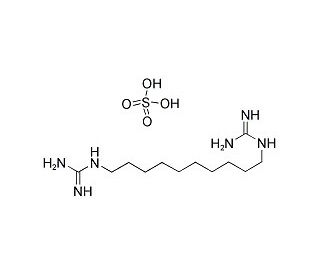

Synthalin sulfate (CAS 111-23-9)
QUICK LINKS
Developed in the mid-1980s by a Japanese pharmaceutical company, Synthalin sulfate is an alkylated and branched-chain synthetic amino acid derived from L-isoleucine. It has found extensive applications in medical and scientific research, contributing to the understanding of amino acid metabolism, protein structure and function, therapeutic agent development, antibiotic creation, and the effects of amino acid supplementation on microbial growth. Its versatility extends to investigating the impact of branched-chain amino acids on muscle growth, development, and exercise performance. Notably, Synthalin sulfate acts as a competitive antagonist at the polyamine site of the NMDA receptor, reducing proton inhibition and exhibiting binding properties beyond a singular site. Previous research supports the ability of polyamines to reduce proton inhibition of NMDA channels in vitro. Mechanistically, Synthalin sulfate is believed to enhance the activity of enzymes involved in branched-chain amino acid metabolism, such as branched-chain amino acid transferase and branched-chain amino acid dehydrogenase. Additionally, it is thought to augment the activity of branched-chain keto acid dehydrogenase, another enzyme in the metabolic pathway. Furthermore, Synthalin sulfate is postulated to stimulate the production of glutathione, a antioxidant.
Synthalin sulfate (CAS 111-23-9) References
- Interactions between zinc and spermidine on the N-methyl-D-aspartate receptor complex: clues to the mechanism of action of 1,10-bis(guanidino)decane and pentamidine. | Reynolds, IJ. 1992. J Pharmacol Exp Ther. 263: 632-8. PMID: 1432693
- 1,10-bis(guanidino)decane inhibits N-methyl-D-aspartate responses in vitro and in vivo. | Reynolds, IJ., et al. 1991. J Pharmacol Exp Ther. 259: 626-32. PMID: 1658306
- The effects of polyamine agonists and antagonists on N-methyl-D-aspartate-induced depolarizations of amphibian motoneurons in situ. | Hackman, JC. and Holohean, AM. 2010. Brain Res. 1325: 10-8. PMID: 20156426
- Competition between covalent and noncovalent bond cleavages in dissociation of phosphopeptide-amine complexes. | Laskin, J., et al. 2011. Phys Chem Chem Phys. 13: 6936-46. PMID: 21387029
- Sarcoplasmic reticulum K(+) (TRIC) channel does not carry essential countercurrent during Ca(2+) release. | Guo, T., et al. 2013. Biophys J. 105: 1151-60. PMID: 24010658
Ordering Information
| Product Name | Catalog # | UNIT | Price | Qty | FAVORITES | |
Synthalin sulfate, 10 mg | sc-200476 | 10 mg | $300.00 | |||
Synthalin sulfate, 50 mg | sc-200476A | 50 mg | $800.00 |