
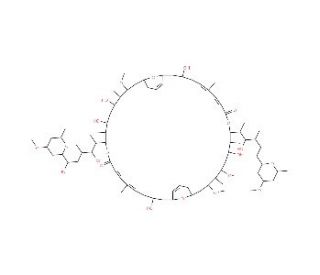

Swinholide I
QUICK LINKS
Swinholide I is a member of the swinholide family, a group of dimeric macrolide compounds isolated from marine sponges, specifically those of the genus Theonella. This natural product is notable for its unique structure, consisting of two monomers linked by a rare thiazole-bridged 44-membered lactone ring. The complex architecture of Swinholide I contributes to its distinct biological activities, particularly its ability to disrupt the cytoskeleton of cells. The primary mechanism of action of Swinholide I involves the sequestration of actin, one of the key proteins responsible for maintaining and restructuring the cellular cytoskeleton. By binding to actin, Swinholide I effectively prevents the polymerization of actin monomers into filaments, leading to a breakdown in the actin cytoskeleton. This disruption has profound effects on cell morphology, motility, and division. In research, Swinholide I has been utilized as a potent tool to study cell dynamics and cytoskeletal organization. It helps scientists explore the fundamental aspects of cell architecture and provides insights into the cellular processes that depend on the structural integrity of actin networks. Through these studies, Swinholide I aids in advancing our understanding of cellular mechanics and the roles of cytoskeletal proteins in various biological functions.
Swinholide I References
- Structural basis of swinholide A binding to actin. | Klenchin, VA., et al. 2005. Chem Biol. 12: 287-91. PMID: 15797212
- Hurghadolide A and swinholide I, potent actin-microfilament disrupters from the Red Sea sponge Theonella swinhoei. | Youssef, DT. and Mooberry, SL. 2006. J Nat Prod. 69: 154-7. PMID: 16441091
- Natural products from the Lithistida: a review of the literature since 2000. | Winder, PL., et al. 2011. Mar Drugs. 9: 2643-2682. PMID: 22363244
- Natural Products Repertoire of the Red Sea. | El-Hossary, EM., et al. 2020. Mar Drugs. 18: PMID: 32899763
- Marine-Derived Macrolides 1990-2020: An Overview of Chemical and Biological Diversity. | Zhang, H., et al. 2021. Mar Drugs. 19: PMID: 33806230
- Inducible erythromycin resistance in bacteria. | Weisblum, B. 1984. Br Med Bull. 40: 47-53. PMID: 6442874
- Two classes of metabolites from Theonella swinhoei are localized in distinct populations of bacterial symbionts. | Bewley, CA., et al. 1996. Experientia. 52: 716-22. PMID: 8698116
- Autoregulation of actin synthesis responds to monomeric actin levels. | Lyubimova, A., et al. 1997. J Cell Biochem. 65: 469-78. PMID: 9178097
- Actin-depolymerizing effect of dimeric macrolides, bistheonellide A and swinholide A. | Saito, SY., et al. 1998. J Biochem. 123: 571-8. PMID: 9538245
- Review of natural products from marine organisms in the Red Sea. | Abou El-Ezz, et al. 2017. nternational journal of pharmaceutical sciences and research. 8.3: 940.
Ordering Information
| Product Name | Catalog # | UNIT | Price | Qty | FAVORITES | |
Swinholide I, 10 µg | sc-222333 | 10 µg | $120.00 |