
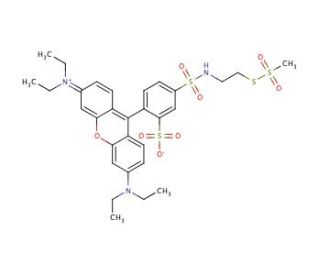

Molecular structure of Sulforhodamine Methanethiosulfonate, CAS Number: 386229-71-6
Sulforhodamine Methanethiosulfonate (CAS 386229-71-6)
Alternate Names:
MTS-rhodamine
Application:
Sulforhodamine Methanethiosulfonate is a fluorescent compound used for modification of sulfhydryl groups
CAS Number:
386229-71-6
Purity:
≥97%
Molecular Weight:
695.89
Molecular Formula:
C30H37N3O8S4
For Research Use Only. Not Intended for Diagnostic or Therapeutic Use.
* Refer to Certificate of Analysis for lot specific data.
QUICK LINKS
Ordering Information
Description
Technical Information
Safety Information
SDS & Certificate of Analysis
Sulforhodamine methanethiosulfonate (SRMT) is a fluorescent dye extensively employed in biological research for multiple purposes. It finds applications in assessing cell viability, studying protein-protein interactions, and examining enzyme activity. The mechanism of Sulforhodamine methanethiosulfonate involves binding to proteins, inducing structural changes that enable fluorescence detection. Moreover, Sulforhodamine methanethiosulfonate has the ability to penetrate cells, facilitating its detection through fluorescence.
Sulforhodamine Methanethiosulfonate (CAS 386229-71-6) References
- Early fluorescence signals detect transitions at mammalian serotonin transporters. | Li, M. and Lester, HA. 2002. Biophys J. 83: 206-18. PMID: 12080113
- Activation of crystalline cellulose surfaces through the chemoenzymatic modification of xyloglucan. | Brumer, H., et al. 2004. J Am Chem Soc. 126: 5715-21. PMID: 15125664
- Detecting rearrangements of shaker and NaChBac in real-time with fluorescence spectroscopy in patch-clamped mammalian cells. | Blunck, R., et al. 2004. Biophys J. 86: 3966-80. PMID: 15189893
- A fluorophore attached to nicotinic acetylcholine receptor beta M2 detects productive binding of agonist to the alpha delta site. | Dahan, DS., et al. 2004. Proc Natl Acad Sci U S A. 101: 10195-200. PMID: 15218096
- Modification of cellulose fiber surfaces by use of a lipase and a xyloglucan endotransglycosylase. | Gustavsson, MT., et al. 2005. Biomacromolecules. 6: 196-203. PMID: 15638521
- Distinct properties of glycine receptor β+/α- interface: unambiguously characterizing heteromeric interface reconstituted in homomeric protein. | Shan, Q., et al. 2012. J Biol Chem. 287: 21244-52. PMID: 22535951
- Analysis of hyperekplexia mutations identifies transmembrane domain rearrangements that mediate glycine receptor activation. | Bode, A. and Lynch, JW. 2013. J Biol Chem. 288: 33760-33771. PMID: 24097980
- New hyperekplexia mutations provide insight into glycine receptor assembly, trafficking, and activation mechanisms. | Bode, A., et al. 2013. J Biol Chem. 288: 33745-33759. PMID: 24108130
- Transport of lipophilic carboxylates is mediated by transmembrane helix 2 in multidrug transporter AcrB. | Oswald, C., et al. 2016. Nat Commun. 7: 13819. PMID: 27982032
- Thiol-reactive drug substrates of human P-glycoprotein label the same sites to activate ATPase activity in membranes or dodecyl maltoside detergent micelles. | Loo, TW. and Clarke, DM. 2017. Biochem Biophys Res Commun. 488: 573-577. PMID: 28533092
- Electrostatic potential of the acetylcholine binding sites in the nicotinic receptor probed by reactions of binding-site cysteines with charged methanethiosulfonates. | Stauffer, DA. and Karlin, A. 1994. Biochemistry. 33: 6840-9. PMID: 8204619
- Molecular basis of charge movement in voltage-gated sodium channels. | Yang, N., et al. 1996. Neuron. 16: 113-22. PMID: 8562074
- Structure of the NMDA receptor channel M2 segment inferred from the accessibility of substituted cysteines. | Kuner, T., et al. 1996. Neuron. 17: 343-52. PMID: 8780657
Ordering Information
| Product Name | Catalog # | UNIT | Price | Qty | FAVORITES | |
Sulforhodamine Methanethiosulfonate, 5 mg | sc-220172 | 5 mg | $301.00 |