
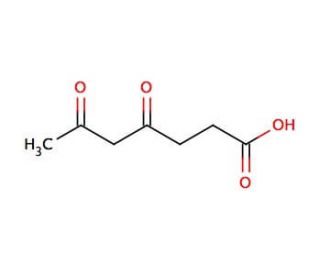

Succinylacetone (CAS 51568-18-4)
QUICK LINKS
Succinylacetone is an organic compound widely employed in scientific research as an inhibitor of the enzyme 5-aminolevulinic acid dehydratase (ALAD), which is pivotal in the biosynthesis of heme, the iron-containing compound found in hemoglobin. Researchers use Succinylacetone to study the metabolic pathways involved in heme production and to understand the biochemical basis of certain metabolic disorders. It is also used as a standard in analytical techniques like chromatography for the quantification of its concentration in biological samples. In biochemistry, it serves as a tool to probe the effects of disrupted heme synthesis on cellular processes. Furthermore, Succinylacetone′s role in research extends to agricultural science, where it is involved in studies on plant growth and development, particularly in relation to chlorophyll production and the synthesis of other heme-containing enzymes essential for plant metabolism.
Succinylacetone (CAS 51568-18-4) References
- Spectrophotometric microassay for delta-aminolevulinate dehydratase in dried-blood spots as confirmation for hereditary tyrosinemia type I. | Schulze, A., et al. 2001. Clin Chem. 47: 1424-9. PMID: 11468232
- Treatment of hereditary tyrosinaemia type I by inhibition of 4-hydroxyphenylpyruvate dioxygenase. | Lindstedt, S., et al. 1992. Lancet. 340: 813-7. PMID: 1383656
- Newborn screening for hepatorenal tyrosinemia by tandem mass spectrometry: analysis of succinylacetone extracted from dried blood spots. | Allard, P., et al. 2004. Clin Biochem. 37: 1010-5. PMID: 15498530
- Tyrosinaemia type I--an update. | Kvittingen, EA. 1991. J Inherit Metab Dis. 14: 554-62. PMID: 1749221
- [Application of succinylacetone levels measurement in the blood and urine in the diagnosis of tyrosinemia type 1]. | Han, LS., et al. 2012. Zhonghua Er Ke Za Zhi. 50: 126-30. PMID: 22455637
- Plasma succinylacetone is persistently raised after liver transplantation in tyrosinaemia type 1. | Bartlett, DC., et al. 2013. J Inherit Metab Dis. 36: 15-20. PMID: 22456946
- Urinary Succinylacetone Analysis by Gas Chromatography-Mass Spectrometry (GC-MS). | Chen, H. and Yu, C. 2016. Methods Mol Biol. 1378: 281-90. PMID: 26602140
- A GC/MS method for determination of succinylacetone in Arabidopsis thaliana. | Zhou, L., et al. 2016. Anal Bioanal Chem. 408: 4661-7. PMID: 27086013
- Simultaneous quantification of succinylacetone and nitisinone for therapeutic drug monitoring in the treatment of Tyrosinemia type 1. | Sundberg, J., et al. 2018. J Chromatogr B Analyt Technol Biomed Life Sci. 1072: 259-266. PMID: 29195145
- Inter-laboratory analytical improvement of succinylacetone and nitisinone quantification from dried blood spot samples. | Laeremans, H., et al. 2020. JIMD Rep. 53: 90-102. PMID: 32395414
- The Importance of Succinylacetone: Tyrosinemia Type I Presenting with Hyperinsulinism and Multiorgan Failure Following Normal Newborn Screening. | Priestley, JRC., et al. 2020. Int J Neonatal Screen. 6: PMID: 32832707
- Hereditary tyrosinemia type Ⅰ: newborn screening, diagnosis and treatment. | Tang, Y. and Kong, Y. 2021. Zhejiang Da Xue Xue Bao Yi Xue Ban. 50: 514-523. PMID: 34704422
- Development of Flow Injection Analysis Method for the Second-Tier Estimation of Succinylacetone in Dried Blood Spot of Newborn Screening. | Varughese, B., et al. 2022. Indian J Clin Biochem. 37: 40-50. PMID: 35125692
Ordering Information
| Product Name | Catalog # | UNIT | Price | Qty | FAVORITES | |
Succinylacetone, 10 mg | sc-212963 | 10 mg | $336.00 | |||
Succinylacetone, 100 mg | sc-212963B | 100 mg | $418.00 |