
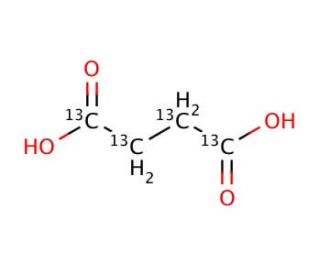

Succinic acid-13C4 (CAS 201595-67-7)
QUICK LINKS
Succinic acid-13C4 is a stable, non-radioactive isotope of succinic acid. It is produced in the citric acid cycle and plays a key role in the generation of adenosine triphosphate (ATP) through oxidative phosphorylation. Succinic acid-13C4 is labeled with four carbon-13 atoms, making it a function for metabolic studies using nuclear magnetic resonance (NMR) spectroscopy. By incorporating carbon-13 into the succinic acid molecule, the metabolic fate of this important intermediate can be tracked in various biological systems. This labeled compound is particularly useful in tracing the flux of carbon atoms through the citric acid cycle and related metabolic pathways. Its stable isotope labeling allows for precise and accurate measurements of metabolic fluxes, providing insights into cellular metabolism and energy production. Succinic acid-13C4 is useful for studying metabolic processes in biochemistry and related fields.
Succinic acid-13C4 (CAS 201595-67-7) References
- A quantitative liquid chromatography tandem mass spectrometry method for metabolomic analysis of Plasmodium falciparum lipid related metabolites. | Vo Duy, S., et al. 2012. Anal Chim Acta. 739: 47-55. PMID: 22819049
- Targeted Metabolomic Analysis of Head and Neck Cancer Cells Using High Performance Ion Chromatography Coupled with a Q Exactive HF Mass Spectrometer. | Hu, S., et al. 2015. Anal Chem. 87: 6371-9. PMID: 25973679
- Changes in the uterine metabolome of the cow during the first 7 days after estrus. | Tríbulo, P., et al. 2019. Mol Reprod Dev. 86: 75-87. PMID: 30383328
- Limitation of TCA Cycle Intermediates Represents an Oxygen-Independent Nutritional Antibacterial Effector Mechanism of Macrophages. | Hayek, I., et al. 2019. Cell Rep. 26: 3502-3510.e6. PMID: 30917307
- Muscle-Liver Substrate Fluxes in Exercising Humans and Potential Effects on Hepatic Metabolism. | Hu, C., et al. 2020. J Clin Endocrinol Metab. 105: 1196-209. PMID: 31825515
- Human Prostate Cancer is Characterized by an Increase in Urea Cycle Metabolites. | Franko, A., et al. 2020. Cancers (Basel). 12: PMID: 32640711
- TCR-Independent Metabolic Reprogramming Precedes Lymphoma-Driven Changes in T-cell Fate. | Hesterberg, RS., et al. 2022. Cancer Immunol Res. 10: 1263-1279. PMID: 35969234
- Gut bacterial nutrient preferences quantified in vivo. | Zeng, X., et al. 2022. Cell. 185: 3441-3456.e19. PMID: 36055202
- Dyskeratosis Congenita links telomere attrition to age-related systemic energetics. | James, EN., et al. 2023. J Gerontol A Biol Sci Med Sci.. PMID: 36651908
- 13C- and 14C-labelling of N-[1-(4-chlorophenyl)-1H-pyrrol-2-yl-methyleneamino] guanidinium acetate | Almeida, M., Johannesson, P., Boman, A., & Lundstedt, T. 2005. The Official Journal of the International Isotope Society. 48(8): 621-627.
Ordering Information
| Product Name | Catalog # | UNIT | Price | Qty | FAVORITES | |
Succinic acid-13C4, 100 mg | sc-229340 | 100 mg | $898.00 |