
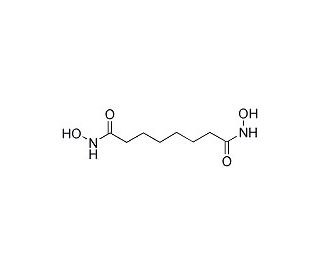

Suberoyl bis-hydroxamic Acid (CAS 38937-66-5)
QUICK LINKS
Suberoyl bis-hydroxamic acid (SBHA) is an organic compound with potent properties as a histone deacetylase (HDAC) inhibitor, primarily utilized in molecular biology research to explore gene expression and chromatin dynamics. SBHA functions by binding to the zinc ions within the active site of HDACs, thus inhibiting their deacetylase activity which is critical for chromatin remodeling and subsequent gene transcription regulation. The inhibition of HDACs leads to an increased acetylation of histone proteins, resulting in a more open chromatin structure and promoting transcriptional activation of previously silenced genes. This mechanism is vital for understanding the epigenetic regulation of gene expression and has significant implications in the study of developmental biology and oncogenesis. Researchers leverage SBHA to dissect the roles of specific genes and their associated pathways in cellular differentiation, apoptosis, and cellular response to stress. Its application extends to studying the modulation of inflammatory responses and immune signaling pathways, showcasing its versatility and importance in elucidating complex biological processes. As such, SBHA serves as a crucial tool in the arsenal of researchers aiming to unravel the complex web of epigenetic regulation at the molecular level.
Suberoyl bis-hydroxamic Acid (CAS 38937-66-5) References
- Suberoyl bis-hydroxamic acid activates Notch-1 signaling and induces apoptosis in medullary thyroid carcinoma cells. | Ning, L., et al. 2008. Oncologist. 13: 98-104. PMID: 18305053
- Suberoyl bis-hydroxamic acid induces p53-dependent apoptosis of MCF-7 breast cancer cells. | Zhuang, ZG., et al. 2008. Acta Pharmacol Sin. 29: 1459-66. PMID: 19026165
- HDAC inhibitors, MS275 and SBHA, enhances cytotoxicity induced by oxaliplatin in the colorectal cancer cell lines. | Flis, S., et al. 2009. Biochem Biophys Res Commun. 387: 336-41. PMID: 19596269
- Suberoyl bishydroxamic acid inhibits the growth of A549 lung cancer cells via caspase-dependent apoptosis. | You, BR. and Park, WH. 2010. Mol Cell Biochem. 344: 203-10. PMID: 20652372
- Suberoyl bishydroxamic acid-induced apoptosis in HeLa cells via ROS-independent, GSH-dependent manner. | You, BR. and Park, WH. 2013. Mol Biol Rep. 40: 3807-16. PMID: 23269626
- Histone deacetylase inhibitor suberoyl bis-hydroxamic acid suppresses cell proliferation and induces apoptosis in breast cancer cells. | Yang, X., et al. 2015. Mol Med Rep. 11: 2908-12. PMID: 25501628
- Reactive oxygen species, glutathione, and thioredoxin influence suberoyl bishydroxamic acid-induced apoptosis in A549 lung cancer cells. | You, BR., et al. 2015. Tumour Biol. 36: 3429-39. PMID: 25537089
- Suberoyl bis-hydroxamic acid enhances cytotoxicity induced by proteasome inhibitors in breast cancer cells. | Yang, X., et al. 2014. Cancer Cell Int. 14: 107. PMID: 25729327
- Down-Regulation of Thioredoxin1 Is Involved in Death of Calu-6 Lung Cancer Cells Treated With Suberoyl Bishydroxamic Acid. | You, BR. and Park, WH. 2016. J Cell Biochem. 117: 1250-61. PMID: 26460805
- Suberoyl bis-hydroxamic acid activates Notch1 signaling and induces apoptosis in anaplastic thyroid carcinoma through p53. | Li, J., et al. 2017. Oncol Rep. 37: 458-464. PMID: 28004113
- Suberoyl bis-hydroxamic acid reactivates Kaposi's sarcoma-associated herpesvirus through histone acetylation and induces apoptosis in lymphoma cells. | Iida, S., et al. 2021. J Virol. 95: PMID: 33328303
- BAHD acyltransferase induced by histone deacetylase inhibitor catalyzes 3-O-hydroxycinnamoylquinic acid formation in bamboo cells. | Nomura, T., et al. 2022. Plant J. 112: 1266-1280. PMID: 36305861
- Cytodifferentiating agents affect the replication of herpes simplex virus type 1 in the absence of functional VP16. | Preston, CM. and McFarlane, M. 1998. Virology. 249: 418-26. PMID: 9791032
Ordering Information
| Product Name | Catalog # | UNIT | Price | Qty | FAVORITES | |
Suberoyl bis-hydroxamic Acid, 100 mg | sc-200887 | 100 mg | $50.00 | |||
Suberoyl bis-hydroxamic Acid, 500 mg | sc-200887A | 500 mg | $104.00 |