
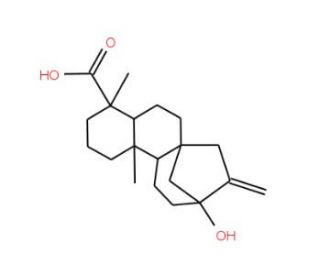

Steviol (CAS 471-80-7)
QUICK LINKS
Chemically, steviol is characterized by its complex structure, which includes multiple hydroxyl groups and a rigid, ring-based backbone. This structure is significant in the field of organic chemistry and biochemistry for its role in the natural synthesis of sweet-tasting compounds. The process of glycosylation, where sugar molecules are attached to the steviol backbone, significantly alters the properties of the molecule, including its solubility, stability, and taste profile. In addition to its role in the biosynthesis of sweet compounds, steviol is of interest in research due to its unique structure and the pathways involved in its production and modification. Studies on steviol and its derivatives can provide insights into plant biochemistry, specifically how plants produce a wide array of chemical compounds with diverse and often complex structures. Furthermore, the extraction and processing of steviol derivatives highlight important techniques in natural product chemistry, including purification, characterization, and modification of compounds found in plant sources. Overall, steviol serves as a foundational compound in the study and application of natural sweeteners, offering a fascinating glimpse into the chemical diversity of plant-derived substances and their potential uses in industry and research.
Steviol (CAS 471-80-7) References
- A critical review of the genetic toxicity of steviol and steviol glycosides. | Brusick, DJ. 2008. Food Chem Toxicol. 46 Suppl 7: S83-91. PMID: 18556105
- Steviol glucuronidation and its potential interaction with UDP-glucuronosyltransferase 2B7 substrates. | Wang, M., et al. 2014. Food Chem Toxicol. 64: 135-43. PMID: 24296138
- Production of steviol from steviol glucosides using β-glycosidase from Sulfolobus solfataricus. | Nguyen, TT., et al. 2016. Enzyme Microb Technol. 93-94: 157-165. PMID: 27702476
- Steviol slows renal cyst growth by reducing AQP2 expression and promoting AQP2 degradation. | Noitem, R., et al. 2018. Biomed Pharmacother. 101: 754-762. PMID: 29524884
- Steviol, a natural product inhibits proliferation of the gastrointestinal cancer cells intensively. | Chen, J., et al. 2018. Oncotarget. 9: 26299-26308. PMID: 29899860
- Diterpenoid lead stevioside and its hydrolysis products steviol and isosteviol: Biological activity and structural modification. | Wang, M., et al. 2018. Eur J Med Chem. 156: 885-906. PMID: 30059803
- Redesign and reconstruction of a steviol-biosynthetic pathway for enhanced production of steviol in Escherichia coli. | Moon, JH., et al. 2020. Microb Cell Fact. 19: 20. PMID: 32013995
- Diversity-Oriented Library Synthesis from Steviol and Isosteviol-Derived Scaffolds. | Holth, TAD., et al. 2020. ACS Comb Sci. 22: 150-155. PMID: 32065745
- Steviol, the active principle of the stevia sweetener, causes a reduction of the cells of the immunological system even consumed in low concentrations. | Pasqualli, T., et al. 2020. Immunopharmacol Immunotoxicol. 42: 504-508. PMID: 32811239
- Bioconversion of steviol glycosides into steviol by Microbacterium barkeri. | Jiang, HL., et al. 2021. J Asian Nat Prod Res. 23: 1057-1067. PMID: 33135498
- Validation of an HPLC Method for Pretreatment of Steviol Glycosides in Fermented Milk. | Kim, JM., et al. 2021. Foods. 10: PMID: 34681493
- Characterization of Microbial Degradation Products of Steviol Glycosides. | Steurs, G., et al. 2021. Molecules. 26: PMID: 34834008
- Steviol Represses Glucose Metabolism and Translation Initiation in Pancreatic Cancer Cells. | Kumari, S., et al. 2021. Biomedicines. 9: PMID: 34944630
- Synthesis and in vivo evaluation of new steviol derivatives that protect against cardiomyopathy by inhibiting ferroptosis. | Xu, C., et al. 2022. Bioorg Chem. 129: 106142. PMID: 36150232
- Steviol and steviol-glycoside: glucosyltransferase activities in Stevia rebaudiana Bertoni--purification and partial characterization. | Shibata, H., et al. 1995. Arch Biochem Biophys. 321: 390-6. PMID: 7646064
Ordering Information
| Product Name | Catalog # | UNIT | Price | Qty | FAVORITES | |
Steviol, 10 mg | sc-253605A | 10 mg | $192.00 | |||
Steviol, 50 mg | sc-253605 | 50 mg | $860.00 |