
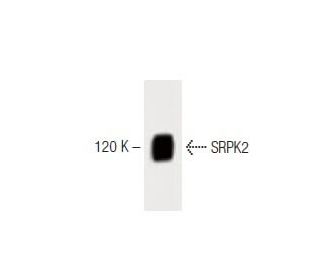


SRPK2 Antibody (23): sc-136078
- SRPK2 Antibody (23) is a mouse monoclonal IgG1, cited in 4 publications, provided at 50 µg/0.5 ml
- raised against amino acids 363-485 of SRPK2 of human origin
- recommended for detection of SRPK2 of mouse, rat, human and canine origin by WB, IP and IF
- At present, we have not yet completed the identification of the preferred secondary detection reagent(s) for SRPK2 Antibody (23). This work is in progress.

QUICK LINKS
SRPK2 Antibody (23) is a mouse monoclonal IgG1 antibody that detects SRPK2 in mouse, rat, human, and canine samples through applications such as western blotting (WB), immunoprecipitation (IP), and immunofluorescence (IF). SRPK2, a member of the serine/arginine-rich protein kinase family, plays a crucial role in the regulation of pre-mRNA splicing by phosphorylating serine/arginine-rich (SR) proteins, which are essential for both constitutive and alternative splicing processes. The phosphorylation of SR proteins by SRPK2 is vital for coordinating splicing with transcription, ensuring that gene expression is accurately regulated in response to cellular signals. Notably, SRPK2 exhibits a stringent preference for SR dipeptides and features a proline-rich sequence at its amino terminus, which may influence interactions with other proteins involved in splicing regulation. SRPK2 expression is particularly significant in tissues such as the brain, heart, liver, and lung, where anti-SRPK2 antibody (23) can help reveal dynamic regulation of gene expression necessary for proper cellular function. SRPK2 (23) monoclonal antibody serves as an invaluable tool for researchers studying the intricate mechanisms of splicing regulation and the role of post-translational modifications in gene expression.
Alexa Fluor® is a trademark of Molecular Probes Inc., OR., USA
LI-COR® and Odyssey® are registered trademarks of LI-COR Biosciences
SRPK2 Antibody (23) References:
- SRPK2 phosphorylates tau and mediates the cognitive defects in Alzheimer's disease. | Hong, Y., et al. 2012. J Neurosci. 32: 17262-72. PMID: 23197718
- SRPK2 promotes the growth and migration of the colon cancer cells. | Wang, J., et al. 2016. Gene. 586: 41-7. PMID: 27041240
- Post-transcriptional Regulation of De Novo Lipogenesis by mTORC1-S6K1-SRPK2 Signaling. | Lee, G., et al. 2017. Cell. 171: 1545-1558.e18. PMID: 29153836
- Insights into the full-length SRPK2 structure and its hydrodynamic behavior. | Barbosa, ÉAA., et al. 2019. Int J Biol Macromol. 137: 205-214. PMID: 31229549
- Downregulation of SRPK2 promotes cell cycle arrest though E2F1 in non-small cell lung cancer. | Li, X., et al. 2019. Eur J Histochem. 63: PMID: 31833327
- Cooperation of SRPK2, Numb and p53 in the malignant biology and chemosensitivity of colorectal cancer. | Wang, G., et al. 2020. Biosci Rep. 40: PMID: 31898732
- SRPK2 Expression and Beta-Amyloid Accumulation Are Associated With BV2 Microglia Activation. | Tian, Z., et al. 2021. Front Integr Neurosci. 15: 742377. PMID: 35153686
- An IGF-1R-mTORC1-SRPK2 signaling Axis contributes to FASN regulation in breast cancer. | McClellan, B., et al. 2022. BMC Cancer. 22: 976. PMID: 36096767
- SRPK2 Mediates HBV Core Protein Phosphorylation and Capsid Assembly via Docking Interaction. | Yip, RPH., et al. 2024. PLoS Pathog. 20: e1011978. PMID: 38324561
- LTR retrotransposon-derived LncRNA LINC01446 promotes hepatocellular carcinoma progression and angiogenesis by regulating the SRPK2/SRSF1/VEGF axis. | Wu, Y., et al. 2024. Cancer Lett. 598: 217088. PMID: 38945203
Ordering Information
| Product Name | Catalog # | UNIT | Price | Qty | FAVORITES | |
SRPK2 Antibody (23) | sc-136078 | 50 µg/0.5 ml | $322.00 |