
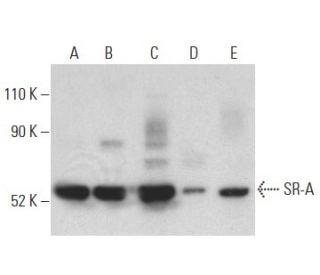
SR-A Antibody (E-5): sc-166184
- SR-A Antibody (E-5) is a mouse monoclonal IgG2a κ SR-A antibody, cited in 15 publications, provided at 200 µg/ml
- raised against amino acids 61-250 of SR-A of human origin
- SR-A Antibody (E-5) is recommended for detection of SR-A of human origin by WB, IP, IF, IHC(P) and ELISA
- Anti-SR-A Antibody (E-5) is available conjugated to agarose for IP; HRP for WB, IHC(P) and ELISA; and to either phycoerythrin or FITC for IF, IHC(P) and FCM
- also available conjugated to Alexa Fluor® 488, Alexa Fluor® 546, Alexa Fluor® 594 or Alexa Fluor® 647 for WB (RGB), IF, IHC(P) and FCM, and for use with RGB fluorescent imaging systems, such as iBright™ FL1000, FluorChem™, Typhoon, Azure and other comparable systems
- also available conjugated to Alexa Fluor® 680 or Alexa Fluor® 790 for WB (NIR), IF and FCM; for use with Near-Infrared (NIR) detection systems, such as LI-COR®Odyssey®, iBright™ FL1000, FluorChem™, Typhoon, Azure and other comparable systems
- m-IgG2a BP-HRP is the preferred secondary detection reagent for SR-A Antibody (E-5) for WB and IHC(P) applications. This reagent is now offered in a bundle with SR-A Antibody (E-5) (see ordering information below).

QUICK LINKS
SR-A Antibody (E-5) is a mouse monoclonal IgG2a kappa light chain antibody that detects SR-A protein of human origin by western blotting (WB), immunoprecipitation (IP), immunofluorescence (IF), immunohistochemistry, and enzyme-linked immunosorbent assay (ELISA). SR-A (E-5) antibody is available in both non-conjugated and various conjugated forms, including agarose, horseradish peroxidase (HRP), phycoerythrin (PE), fluorescein isothiocyanate (FITC), and multiple Alexa Fluor® conjugates. The scavenger receptor class A (SR-A) plays a crucial role in lipid metabolism by mediating the uptake of modified low-density lipoprotein (LDL), which is significant for understanding atherosclerosis and other lipid-related diseases. The gene encoding human SR-A is located on chromosome 8 and produces two main isoforms, SR-AI and SR-AII, through alternative splicing. These isoforms consist of six distinct domains: a cytoplasmic domain, a membrane-spanning domain, a spacer domain, an alpha-helical coiled-coil domain, a collagen-like domain, and a type-specific C-terminal domain. The alpha-helical coiled-coil domain enables SR-A trimerization, while the collagen-like domain recognizes diverse ligands. SR-A expression occurs predominantly in the liver, placenta, and brain, with both isoforms facilitating LDL uptake in atherosclerotic lesions. A third isoform, SR-AIII, does not facilitate LDL uptake and may serve as a dominant negative isoform, potentially providing a protective mechanism for cells in advanced atherosclerotic lesions. Beyond lipid metabolism, SR-A contributes to various macrophage-associated pathological processes, including atherosclerosis and Alzheimer′s disease, as well as host defense and cellular adhesion.
Alexa Fluor® is a trademark of Molecular Probes Inc., OR., USA
LI-COR® and Odyssey® are registered trademarks of LI-COR Biosciences
SR-A Antibody (E-5) References:
- Analysis of macrophage scavenger receptor (SR-A) expression in human aortic atherosclerotic lesions. | Gough, PJ., et al. 1999. Arterioscler Thromb Vasc Biol. 19: 461-71. PMID: 10073945
- Class A scavenger receptor up-regulation in smooth muscle cells by oxidized low density lipoprotein. Enhancement by calcium flux and concurrent cyclooxygenase-2 up-regulation. | Mietus-Snyder, M., et al. 2000. J Biol Chem. 275: 17661-70. PMID: 10837497
- Rabbit atherosclerotic lesions express scavenger receptor AIII mRNA, a naturally occurring splice variant that encodes a non-functional, dominant negative form of the macrophage scavenger receptor. | Hiltunen, TP., et al. 2001. Atherosclerosis. 154: 415-9. PMID: 11166774
- The class A scavenger receptor binds to proteoglycans and mediates adhesion of macrophages to the extracellular matrix. | Santiago-García, J., et al. 2003. J Biol Chem. 278: 6942-6. PMID: 12488451
- A role for class A scavenger receptor in dendritic cell nibbling from live cells. | Harshyne, LA., et al. 2003. J Immunol. 170: 2302-9. PMID: 12594251
- Class A scavenger receptor-mediated cell adhesion requires the sequential activation of Lyn and PI3-kinase. | Nikolic, DM., et al. 2007. Am J Physiol Cell Physiol. 292: C1450-8. PMID: 17192284
- Class A scavenger receptor promotes osteoclast differentiation via the enhanced expression of receptor activator of NF-kappaB (RANK). | Takemura, K., et al. 2010. Biochem Biophys Res Commun. 391: 1675-80. PMID: 20036645
- Increased class A scavenger receptor and glomerular lipid precede mesangial matrix expansion in the bGH mouse model. | Doi, SQ., et al. 2010. Growth Horm IGF Res. 20: 326-32. PMID: 20576456
- Human macrophage scavenger receptors: primary structure, expression, and localization in atherosclerotic lesions. | Matsumoto, A., et al. 1990. Proc Natl Acad Sci U S A. 87: 9133-7. PMID: 2251254
- Multiple function of macrophage scavenger receptors mediated by fibrous coiled coil domains. | Liao, HS., et al. 1996. Gerontology. 42 Suppl 1: 37-47. PMID: 8964521
- Scavenger receptors mediate adhesion of activated B lymphocytes. | Yokota, T., et al. 1998. Exp Cell Res. 239: 16-22. PMID: 9511720
- A naturally occurring isoform of the human macrophage scavenger receptor (SR-A) gene generated by alternative splicing blocks modified LDL uptake. | Gough, PJ., et al. 1998. J Lipid Res. 39: 531-43. PMID: 9548586
Ordering Information
| Product Name | Catalog # | UNIT | Price | Qty | FAVORITES | |
SR-A Antibody (E-5) | sc-166184 | 200 µg/ml | $322.00 | |||
SR-A Antibody (E-5): m-IgG2a BP-HRP Bundle | sc-545925 | 200 µg Ab; 10 µg BP | $361.00 | |||
SR-A Antibody (E-5) AC | sc-166184 AC | 500 µg/ml, 25% agarose | $424.00 | |||
SR-A Antibody (E-5) HRP | sc-166184 HRP | 200 µg/ml | $322.00 | |||
SR-A Antibody (E-5) FITC | sc-166184 FITC | 200 µg/ml | $336.00 | |||
SR-A Antibody (E-5) PE | sc-166184 PE | 200 µg/ml | $349.00 | |||
SR-A Antibody (E-5) Alexa Fluor® 488 | sc-166184 AF488 | 200 µg/ml | $364.00 | |||
SR-A Antibody (E-5) Alexa Fluor® 546 | sc-166184 AF546 | 200 µg/ml | $364.00 | |||
SR-A Antibody (E-5) Alexa Fluor® 594 | sc-166184 AF594 | 200 µg/ml | $364.00 | |||
SR-A Antibody (E-5) Alexa Fluor® 647 | sc-166184 AF647 | 200 µg/ml | $364.00 | |||
SR-A Antibody (E-5) Alexa Fluor® 680 | sc-166184 AF680 | 200 µg/ml | $364.00 | |||
SR-A Antibody (E-5) Alexa Fluor® 790 | sc-166184 AF790 | 200 µg/ml | $364.00 |