
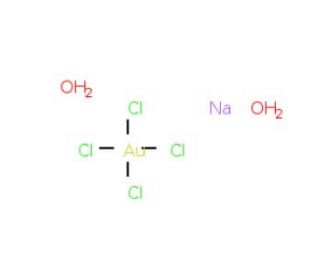

Molecular structure of Sodium tetrachloroaurate(III) dihydrate, CAS Number: 13874-02-7
Sodium tetrachloroaurate(III) dihydrate (CAS 13874-02-7)
Alternate Names:
Sodium Gold(III) Chloride dihydrate; Sodium gold chloride
Application:
Sodium tetrachloroaurate(III) dihydrate is an Au(I) complex
CAS Number:
13874-02-7
Purity:
99%
Molecular Weight:
397.80
Molecular Formula:
NaAuCl4•2H2O
For Research Use Only. Not Intended for Diagnostic or Therapeutic Use.
* Refer to Certificate of Analysis for lot specific data.
QUICK LINKS
Ordering Information
Description
Technical Information
Safety Information
SDS & Certificate of Analysis
Sodium tetrachloroaurate(III) dihydrate is an Au(I) complex which is soluble by water and alcohol, and can form from NaAuCl4. It has potential for application in chemotherapeutics. Used in chemical synthesis as gold catalyst. Can be used as a catalyst in the removal of tert-butyl(dimethyl)silyl (TBS) protecting groups. Selective in the presence of aromatic TBS ethers, aliphatic triisopropylsilyl ethers, or sterically hindered aliphatic TBS ethers. With excess catalyst, TBS ethers can also be transformed into 4-methoxybenzyl ethers or methyl ethers in one pot.
Sodium tetrachloroaurate(III) dihydrate (CAS 13874-02-7) References
- Separation of double-stranded DNA fragments by capillary electrophoresis: Impacts of poly(ethylene oxide), gold nanoparticles, ethidium bromide, and pH. | Chiou, SH., et al. 2004. Electrophoresis. 25: 2186-92. PMID: 15274002
- Auranofin, as an anti-rheumatic gold compound, suppresses LPS-induced homodimerization of TLR4. | Youn, HS., et al. 2006. Biochem Biophys Res Commun. 350: 866-71. PMID: 17034761
- The importance of the CTAB surfactant on the colloidal seed-mediated synthesis of gold nanorods. | Smith, DK. and Korgel, BA. 2008. Langmuir. 24: 644-9. PMID: 18184021
- Sodium tetrachloroaurate(III) dihydrate-catalyzed efficient synthesis of 1,5-benzodiazepine and quinoxaline derivatives. | Shi, RX., et al. 2010. J Zhejiang Univ Sci B. 11: 102-8. PMID: 20104644
- Gold-nanobeacons for simultaneous gene specific silencing and intracellular tracking of the silencing events. | Conde, J., et al. 2013. Biomaterials. 34: 2516-23. PMID: 23312904
- Colorimetric sensing of copper(II) based on catalytic etching of gold nanoparticles. | Liu, R., et al. 2013. Talanta. 112: 37-42. PMID: 23708534
- Gold(III)-mediated contraction of benzene to cyclopentadiene: from p-benziporphyrin to gold(III) true tetraarylcarbaporphyrin. | Szyszko, B., et al. 2014. Chemistry. 20: 1376-82. PMID: 24382653
- Interactions of skin with gold nanoparticles of different surface charge, shape, and functionality. | Fernandes, R., et al. 2015. Small. 11: 713-21. PMID: 25288531
- A sensitive electrochemical genosensor for highly specific detection of thalassemia gene. | Gholivand, MB. and Akbari, A. 2019. Biosens Bioelectron. 129: 182-188. PMID: 30716678
- Unusual Stability and Catalytic Activity of Gold Nanoparticles in Polyoxyethylene Cholesteryl Ether. | Rajput, G., et al. 2020. J Nanosci Nanotechnol. 20: 2171-2178. PMID: 31492226
- Rapid ultra-sensitive diagnosis of clostridium difficile infection using a SERS-based lateral flow assay. | Hassanain, WA., et al. 2021. Analyst. 146: 4495-4505. PMID: 34184680
- Molybdenum Disulfide Supported on Metal-Organic Frameworks as an Ultrasensitive Layer for the Electrochemical Detection of the Ovarian Cancer Biomarker CA125. | Li, S., et al. 2021. ACS Appl Bio Mater. 4: 5494-5502. PMID: 35006743
- Nanozyme-enabled sensing strategies for determining the total antioxidant capacity of food samples. | Zhang, F., et al. 2022. Food Chem. 384: 132412. PMID: 35217460
Ordering Information
| Product Name | Catalog # | UNIT | Price | Qty | FAVORITES | |
Sodium tetrachloroaurate(III) dihydrate, 1 g | sc-251058 | 1 g | $204.00 | |||
Sodium tetrachloroaurate(III) dihydrate, 5 g | sc-251058A | 5 g | $627.00 |