
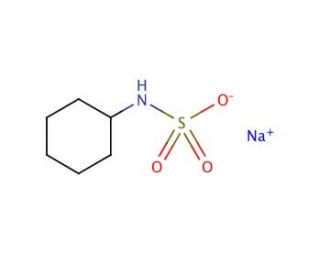

Sodium N-cyclohexylsulfamate (CAS 139-05-9)
QUICK LINKS
Sodium N-cyclohexylsulfamate is used in the field of organic chemistry for the synthesis of sulfamate derivatives. This compound serves as a reagent in the study of sulfamation reactions, which are critical for producing compounds with potential applications in various industrial processes. In research, Sodium N-cyclohexylsulfamate is explored for its role in creating novel chemical entities, particularly those that exhibit unique physical or chemical properties useful in materials science. Sodium N-cyclohexylsulfamate is investigated for its utility in catalysis, specifically in processes that require the transfer of sulfate groups. Researchers also study Sodium N-cyclohexylsulfamate to understand its stability and reactivity under different chemical conditions, aiding in the development of more efficient and selective synthesis techniques.
Sodium N-cyclohexylsulfamate (CAS 139-05-9) References
- Structure-taste relationships for disubstituted phenylsulfamate tastants using classification and regression tree (CART) analysis. | Spillane, WJ., et al. 2006. J Agric Food Chem. 54: 5996-6004. PMID: 16881707
- Indirect determination of cyclamate by an on-line continuous precipitation-dissolution flow system. | Yebra, MC. and Bermejo, P. 1998. Talanta. 45: 1115-22. PMID: 18967103
- Draft Genome Sequence of Cyclohexylamine-Degrading Strain Acinetobacter sp. YT-02 Isolated. | Yan, DZ., et al. 2018. Curr Microbiol. 75: 284-287. PMID: 29063968
- Characterization of a New Cyclohexylamine Oxidase From Acinetobacter sp. YT-02. | Zhou, H., et al. 2018. Front Microbiol. 9: 2848. PMID: 30524413
- Synthesis, Characterization, and Antimicrobial Investigation of a Novel Chlorhexidine Cyclamate Complex. | Dubovoy, V., et al. 2020. Cryst Growth Des. 20: 4991-4999. PMID: 34054352
- Development of a fully water-dilutable mint concentrate based on a food-approved microemulsion. | Benkert, C., et al. 2022. Food Chem. 372: 131230. PMID: 34627088
- Taste agents as modulators of the feeding behaviour of grazing yaks in alpine meadows. | Fan, Q., et al. 2023. Animal. 17: 100703. PMID: 36621111
- Preparation and antibacterial activity of alpha-(5-tetrazolyl) benzylpenicillin. | Essery, JM. 1969. J Med Chem. 12: 703-5. PMID: 4978368
- Polymorphism and thermal behavior of sodium cyclamate | , et al. (2019). Journal of Thermal Analysis and Calorimetry. volume 137,: pages 1307–1313.
- PREPARATION AND PROPERTIES OF SOME N-SUBSTITUTED SULFAMIC ACIDS1 | L. F. AUDRIETH and M. SVEDA. 1944. J. Org. Chem., 09, 1,: 89–101.
- Salting-out and salting-in effects of organic compounds and applications of the salting-out effect of Pentasodium phytate in different extraction processes | G Grundl, M Müller, D Touraud, W Kunz - Journal of Molecular Liquids, 2017 - Elsevier. June 2017,. Journal of Molecular Liquids. Volume 236,: Pages 368-375.
- Forage taste agents modifying yak grazing decrease soil microbial diversity in alpine meadow | Y You, J Ren, J Wu, Z Ma, Y Gu, Y Wang, Z Wang… - Applied Soil …, 2021 - Elsevier. December 2021,. Applied Soil Ecology. Volume 168,: 104160.
- Effect of sulfur in different valence on flame retardance of epoxy resin for light emitting diode | and Chaoyun Luo, Chuang Nan, Jiandong Zuo, Feng Lin. May 5, 2021. Journal of Applied Polymer Science. Volume138, Issue17: 50271.
Ordering Information
| Product Name | Catalog # | UNIT | Price | Qty | FAVORITES | |
Sodium N-cyclohexylsulfamate, 250 g | sc-253592 | 250 g | $65.00 |