
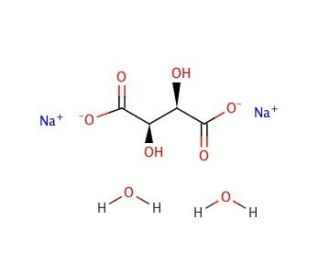

Sodium L-tartrate dibasic dihydrate (CAS 6106-24-7)
QUICK LINKS
Sodium L-tartrate dibasic dihydrate, also known as Sodium tartrate dihydrate, sodium bitartrate, sodium tartar, or tartaric acid salt, is a white crystalline solid compound. It consists of two molecules of tartaric acid and two molecules of sodium hydrate. it serves as a reagent in laboratory experiments, exhibiting diverse biochemical and physiological effects. In scientific research, Sodium L-tartrate dibasic dihydrate assumes a multifaceted role. It acts as a buffer in biochemical and physiological experiments, effectively maintaining a constant pH. Additionally, it functions as a chelating agent, forming complexes with metal ions that can be subsequently separated from the solution. Furthermore, in organic synthesis, Sodium L-tartrate dibasic dihydrate acts as a source of tartaric acid, which is instrumental in the preparation of various salts. The compound′s applications extend to the preparation of salts and as a source of tartaric acid in food and beverage products. Its adaptability and wide-ranging effects make it a valuable component in laboratory applications and various industries.
Sodium L-tartrate dibasic dihydrate (CAS 6106-24-7) References
- Shape evolution of silver nanoplates through heating and photoinduction. | Tang, B., et al. 2013. ACS Appl Mater Interfaces. 5: 646-53. PMID: 23298387
- Nuclear Targeting with an Auger Electron Emitter Potentiates the Action of a Widely Used Antineoplastic Drug. | Imstepf, S., et al. 2015. Bioconjug Chem. 26: 2397-407. PMID: 26473388
- A Morphometric and Cellular Analysis Method for the Murine Mandibular Condyle. | Dutra, EH., et al. 2018. J Vis Exp.. PMID: 29364273
- Insight into tartrate inhibition patterns in vitro and in vivo based on cocrystal structure with UDP-glucuronosyltransferase 2B15. | Zhang, L., et al. 2020. Biochem Pharmacol. 172: 113753. PMID: 31837310
- Bone targeting nanocarrier-assisted delivery of adenosine to combat osteoporotic bone loss. | Hoque, J., et al. 2021. Biomaterials. 273: 120819. PMID: 33892345
- Dual targeting of salt inducible kinases and CSF1R uncouples bone formation and bone resorption. | Tang, CC., et al. 2021. Elife. 10: PMID: 34160349
- Colorimetric and fluorescent TRAP assays for visualising and quantifying fish osteoclast activity. | Ethiraj, LP., et al. 2022. Eur J Histochem. 66: PMID: 35330553
- Robust coupling of angiogenesis and osteogenesis by VEGF-decorated matrices for bone regeneration. | Burger, MG., et al. 2022. Acta Biomater. 149: 111-125. PMID: 35835287
- pH-Sensitive nanocarrier assisted delivery of adenosine to treat osteoporotic bone loss. | Newman, H., et al. 2022. Biomater Sci. 10: 5340-5355. PMID: 35929516
- VEGF dose controls the coupling of angiogenesis and osteogenesis in engineered bone. | Grosso, A., et al. 2023. NPJ Regen Med. 8: 15. PMID: 36914692
- Histochemical identification of osteoclasts. Review of current methods and reappraisal of a simple procedure for routine diagnosis on undecalcified human iliac bone biopsies. | Chappard, D., et al. 1983. Basic Appl Histochem. 27: 75-85. PMID: 6193776
Ordering Information
| Product Name | Catalog # | UNIT | Price | Qty | FAVORITES | |
Sodium L-tartrate dibasic dihydrate, 5 g | sc-203276 | 5 g | $46.00 | |||
Sodium L-tartrate dibasic dihydrate, 100 g | sc-203276A | 100 g | $57.00 | |||
Sodium L-tartrate dibasic dihydrate, 500 g | sc-203276B | 500 g | $128.00 | |||
Sodium L-tartrate dibasic dihydrate, 1 kg | sc-203276C | 1 kg | $225.00 |