
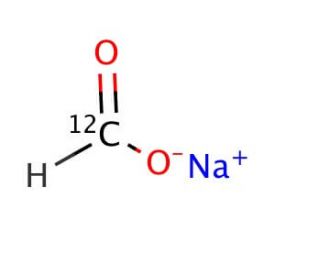

Sodium formate (CAS 141-53-7)
See product citations (7)
QUICK LINKS
Sodium formate is an industrially significant chemical used in a variety of research applications, particularly within organic chemistry and materials science. As a formate salt, it is often employed as a reagent in the synthesis of organic compounds, where it serves as a source of formate ions. These ions are crucial for formylation reactions, which are used to introduce formyl groups into organic molecules, aiding in the modification of molecular structures and the synthesis of complex organic products. Additionally, sodium formate is utilized in the catalysis of certain reactions, providing an alkaline environment that can enhance reaction rates and yields. Beyond its chemical synthesis applications, sodium formate has roles in materials science, particularly in the production and processing of natural fibers and textiles, where it acts as a buffering agent. It is also investigated for its potential use in de-icing applications, where its ability to depress the freezing point of water without corrosive effects on surfaces like runways and roads is of significant interest. These research applications highlight the versatility of sodium formate in both enhancing and enabling various scientific and industrial processes, contributing to advancements in chemical manufacturing and materials handling.
Sodium formate (CAS 141-53-7) References
- An in vivo ESR spin-trapping study: free radical generation in rats from formate intoxication--role of the Fenton reaction. | Dikalova, AE., et al. 2001. Proc Natl Acad Sci U S A. 98: 13549-53. PMID: 11717423
- Studies on the Photosynthetic Reaction. II. Sodium Formate and Urea Feeding Experiments with Nostoc muscorum. | Allison, RK., et al. 1954. Plant Physiol. 29: 164-8. PMID: 16654631
- Purification, crystallization and preliminary crystallographic analysis of mouse myo-inositol oxygenase. | Brown, PM., et al. 2006. Acta Crystallogr Sect F Struct Biol Cryst Commun. 62: 811-3. PMID: 16880565
- Formate acts as a diffusible signal to induce Salmonella invasion. | Huang, Y., et al. 2008. J Bacteriol. 190: 4233-41. PMID: 18424519
- [Study on the mechanism of sodium formate enhancing luminol chemiluminescence and its application in micellar medium]. | Tang, J., et al. 2009. Guang Pu Xue Yu Guang Pu Fen Xi. 29: 2901-3. PMID: 20101949
- Formate-based magnetic metal-organic frameworks templated by protonated amines. | Wang, Z., et al. 2010. Adv Mater. 22: 1526-33. PMID: 20349438
- Sodium formate induces autophagy and apoptosis via the JNK signaling pathway of photoreceptor cells. | Wang, Y., et al. 2016. Mol Med Rep. 13: 1111-8. PMID: 26676762
- Safety Assessment of Formic Acid and Sodium Formate as Used in Cosmetics. | Johnson, W., et al. 2016. Int J Toxicol. 35: 41S-54S. PMID: 27913772
- Sodium formate redirects carbon flux and enhances heterologous mevalonate production in Methylobacterium extorquens AM1. | Cui, LY., et al. 2023. Biotechnol J. 18: e2200402. PMID: 36424513
- Efficacy of sodium formate as a technological feed additive (preservative) for all animal species. | , ., et al. 2020. EFSA J. 18: e06139. PMID: 37649526
Ordering Information
| Product Name | Catalog # | UNIT | Price | Qty | FAVORITES | |
Sodium formate, 100 g | sc-203385 | 100 g | $41.00 | |||
Sodium formate, 500 g | sc-203385A | 500 g | $57.00 | |||
Sodium formate, 2.5 kg | sc-203385B | 2.5 kg | $179.00 |