
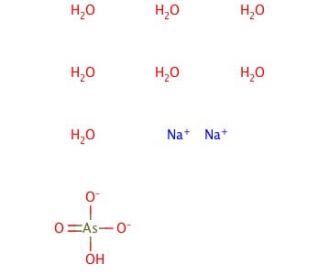

Sodium arsenate dibasic heptahydrate (CAS 10048-95-0)
QUICK LINKS
Sodium arsenate dibasic heptahydrate, also referred to as sodium arsenite heptahydrate or sodium arsenate (VII) heptahydrate, is a crystalline compound that appears white. Comprising of sodium, arsenic, and water, it serves as a salt of arsenous acid and finds extensive application in various practical uses. Sodium arsenate dibasic heptahydrate exerts diverse biochemical and physiological impacts, which are contingent upon its concentration and specific form of utilization. It is hypothesized that the compound interacts with specific proteins and enzymes within the cell, consequently influencing cellular metabolism and gene expression. The effects of Sodium arsenate dibasic heptahydrate encompass various biochemical and physiological responses, dependent on the concentration and manner of employment. Higher concentrations can induce cell death, DNA damage, and modifications in gene expression. Conversely, lower concentrations can prompt changes in cell cycle regulation, apoptosis, and other diverse biochemical and physiological effects.
Sodium arsenate dibasic heptahydrate (CAS 10048-95-0) References
- Transformation by inorganic arsenic compounds of normal Syrian hamster embryo cells into a neoplastic state in which they become anchorage-independent and cause tumors in newborn hamsters. | Takahashi, M., et al. 2002. Int J Cancer. 99: 629-34. PMID: 12115494
- Performance of nanofiltration for arsenic removal. | Sato, Y., et al. 2002. Water Res. 36: 3371-7. PMID: 12188137
- Biosorption of chromium(VI) and arsenic(V) onto methylated yeast biomass. | Seki, H., et al. 2005. J Colloid Interface Sci. 281: 261-6. PMID: 15571680
- Separation and quantification of monothiols and phytochelatins from a wide variety of cell cultures and tissues of trees and other plants using high performance liquid chromatography. | Minocha, R., et al. 2008. J Chromatogr A. 1207: 72-83. PMID: 18760414
- Generation of Tg(cyp1a:gfp) Transgenic Zebrafish for Development of a Convenient and Sensitive In Vivo Assay for Aryl Hydrocarbon Receptor Activity. | Xu, H., et al. 2015. Mar Biotechnol (NY). 17: 831-40. PMID: 26410295
- Arsenic(V) removal using an amine-doped acrylic ion exchange fiber: Kinetic, equilibrium, and regeneration studies. | Lee, CG., et al. 2017. J Hazard Mater. 325: 223-229. PMID: 27940111
- Mitochondrial dysfunction, oxidative stress and apoptotic induction in microglial BV-2 cells treated with sodium arsenate. | Kharroubi, W., et al. 2017. J Environ Sci (China). 51: 44-51. PMID: 28115150
- Rapid micro-assays for amylolytic activities determination: customization and validation of the tests. | Borkowska, M., et al. 2019. Appl Microbiol Biotechnol. 103: 2367-2379. PMID: 30675636
- Arsenic accumulation in lentil (Lens culinaris) genotypes and risk associated with the consumption of grains. | Alam, MZ., et al. 2019. Sci Rep. 9: 9431. PMID: 31263187
- Arsenic accumulation in edible vegetables and health risk reduction by groundwater treatment using an adsorption process. | Spognardi, S., et al. 2019. Environ Sci Pollut Res Int. 26: 32505-32516. PMID: 31617134
- Arsenic exposure combined with nano- or microplastic induces different effects in the marine rotifer Brachionus plicatilis. | Kang, HM., et al. 2021. Aquat Toxicol. 233: 105772. PMID: 33618324
- POSS-Functionalized Graphene Oxide/PVDF Electrospun Membranes for Complete Arsenic Removal Using Membrane Distillation. | Leaper, S., et al. 2021. ACS Appl Polym Mater. 3: 1854-1865. PMID: 34056612
- Behavioural response to toxic elements, detoxification and organ accumulation are time-of-day-dependent in zebrafish. | Guidi, C., et al. 2023. Chemosphere. 316: 137862. PMID: 36642134
- Behaviour of kaolinite intercalation compounds with selected ammonium salts in aqueous chromate and arsenate solutions | Jakub Matusik, Lucyna Matykowska. 2014. Journal of Molecular Structure. 1071: 52-59.
- Synthesis and characterization of ion imprinted polymeric adsorbents for the selective recognition and removal of arsenic and selenium in wastewater samples | Lihle D. Mafu, Bhekie B. Mamba, Titus A.M. Msagati. 2016. Journal of Saudi Chemical Society. 20: 594-605.
Ordering Information
| Product Name | Catalog # | UNIT | Price | Qty | FAVORITES | |
Sodium arsenate dibasic heptahydrate, 50 g | sc-212937 | 50 g | $155.00 | |||
Sodium arsenate dibasic heptahydrate, 100 g | sc-212937A | 100 g | $153.00 | |||
Sodium arsenate dibasic heptahydrate, 500 g | sc-212937B | 500 g | $556.00 |