
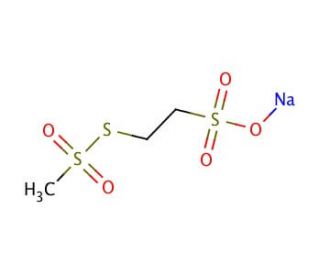

Molecular structure of Sodium (2-Sulfonatoethyl)methanethiosulfonate, CAS Number: 184644-83-5
Sodium (2-Sulfonatoethyl)methanethiosulfonate (CAS 184644-83-5)
See product citations (1)
Alternate Names:
Sodium (2-Sulfonatoethyl)methanethiosulfonate is also known as MTSES.
Application:
Sodium (2-Sulfonatoethyl)methanethiosulfonate is a methanethiosulfonate, a sulfhydryl-reactive probe for GABAA receptor channels.
CAS Number:
184644-83-5
Molecular Weight:
242.26
Molecular Formula:
C3H7O5S3•Na
For Research Use Only. Not Intended for Diagnostic or Therapeutic Use.
* Refer to Certificate of Analysis for lot specific data.
QUICK LINKS
Ordering Information
Product Citations
Description
Technical Information
Safety Information
SDS & Certificate of Analysis
Sodium (2-Sulfonatoethyl)methanethiosulfonate is a probe for GABAA receptor channels. As a methanethiosulfonate, Sodium (2-Sulfonatoethyl)methanethiosulfonate is sulfhydryl-reactive, and may be used to study cysteine residues on proteins. Sodium (2-Sulfonatoethyl)methanethiosulfonate reacts specifically and rapidly with thiols to form mixed disulfides. Sodium (2-Sulfonatoethyl)methanethiosulfonate probes the structures of the ACh receptor channel of the GABAA receptor channel and of lactose permease. Sodium (2-Sulfonatoethyl)methanethiosulfonate works particularly effective at probing native proteins associated with membranes, such as channels and transporters.
Sodium (2-Sulfonatoethyl)methanethiosulfonate (CAS 184644-83-5) References
1. Dunten, R.L., et al.: Biochem., 32, 3139 (1993),2. Yang, N. et al.: Neuron, 16, 113 (1996),
3. Holmgren, M., et al: Neuropharmacology, 35, 797 (1996),
4. Chahine, M., et al.: Biochem. Bio. Res. Commun., 233, 606 (1997),
5. Ehrlich, B.E., et al.: J. Gen. Physiol., 109, 255 (1997),
6. Lang, R.J., Harvey, J.R., and Mulholland, E.L.Sodium (2-sulfonatoethyl) methanethiosulfonate prevents S-nitroso-L-cysteine activation of Ca2+-activated K+ (BKCa) channels in myocytes of the guinea-pig taenia caeca. Br. J. Pharmacol. 139(6), 1153-1163 (2003).
7. Li, R.A., Tsushima, R.G., Kallen, R.G., et al.Pore residues critical for μ-CTX binding to rat skeletal muscle Na+ channels revealed by cysteine mutagenesis. Biophys. J. 73(4), 1874-1884 (1997).
8. Guan, L., and Kaback, H.R.Site-directed alkylation of cysteine to test solvent accessibility of membrane proteins. Nature Protocols 2(8), 2012-2017 (2007).
9. Engh, A.M., and Maduke, M.Cysteine accessibility in ClC-0 supports conservation of the ClC intracellular vestibule. Journal of General Physiology 125(6), 601-617 (2014).
10. Liu, X., Alexander, C., Serrano, J., et al.Variable reactivity of an engineered cysteine at position 338 in cystic fibrosis transmembrane conductance regulator reflects different chemical states of the thiol. The Journal of Biological Chemisty 281(12), 8275-8285 (2006).
Ordering Information
| Product Name | Catalog # | UNIT | Price | Qty | FAVORITES | |
Sodium (2-Sulfonatoethyl)methanethiosulfonate, 250 mg | sc-212933 | 250 mg | $370.00 |