
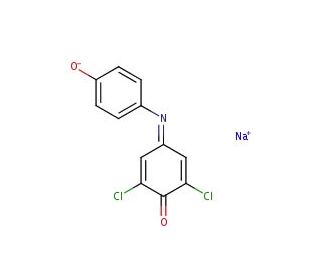

Sodium 2,6-dichloroindophenolate (CAS 620-45-1)
See product citations (3)
QUICK LINKS
Sodium 2,6-dichloroindophenolate, also known by its chemical formula C12H6Cl2NO2Na, is a sodium salt derivative of 2,6-dichloroindophenol. This compound is notable for its deep blue color and is principally used as a colorimetric reagent in various analytical chemistry applications. Its mechanism of action is based on its role as a redox indicator; it is reduced from a blue to a colorless form when it accepts electrons, making it extremely useful for measuring the presence and concentration of substances that can donate electrons. In research, Sodium 2,6-dichloroindophenolate has been extensively used in biochemical assays where it functions as an electron acceptor in the study of enzymatic activities, particularly those involving dehydrogenases. This application is crucial in understanding metabolic pathways and enzyme kinetics. The compound′s sensitivity to changes in redox status allows for the precise quantification of various biological substances, including vitamin C levels in clinical samples and other antioxidants in food and biological fluids. Additionally, its use extends to environmental science, where it aids in the detection of pollutant degradation by acting as an indicator of redox changes in water treatment processes. The ability to operate under mild conditions and its high sensitivity make sodium 2,6-dichloroindophenolate a valuable tool in both academic and industrial laboratories for exploring redox reactions and monitoring chemical processes.
Sodium 2,6-dichloroindophenolate (CAS 620-45-1) References
- A rapid method for the purification of methanol dehydrogenase from Methylobacterium extorquens. | Liu, Q., et al. 2006. Protein Expr Purif. 46: 316-20. PMID: 16139516
- Physiological, biochemical, and genetic characterization of an alicyclic amine-degrading Mycobacterium sp. strain THO100 isolated from a morpholine-containing culture of activated sewage sludge. | Kim, YH., et al. 2006. Arch Microbiol. 186: 425-34. PMID: 16912859
- A simple and highly repeatable colorimetric toxicity assay method using 2,6-dichlorophenolindophenol as the redox color indicator and whole eukaryote cells. | Nakamura, H., et al. 2007. Anal Bioanal Chem. 389: 835-40. PMID: 17717645
- Loss of the SdhB, but Not the SdhA, subunit of complex II triggers reactive oxygen species-dependent hypoxia-inducible factor activation and tumorigenesis. | Guzy, RD., et al. 2008. Mol Cell Biol. 28: 718-31. PMID: 17967865
- Development of square wave voltammetry method for the assessment of organophosphorus compound impact on the cholinesterase of Pheretima with 2,6-dichloroindophenol as a redox indicator. | Qiu, J., et al. 2009. Chemosphere. 77: 129-32. PMID: 19487014
- Tryptophan as a probe of photosystem I electron transfer reactions: a UV resonance Raman study. | Chen, J., et al. 2009. J Phys Chem B. 113: 11367-70. PMID: 19639977
- Sulforaphane prevents quinolinic acid-induced mitochondrial dysfunction in rat striatum. | Luis-García, ER., et al. 2017. J Biochem Mol Toxicol. 31: PMID: 27589053
- The effect of ascorbic acid ingestion on the biochemical and physicochemical risk factors associated with calcium oxalate kidney stone formation. | Auer, BL., et al. 1998. Clin Chem Lab Med. 36: 143-7. PMID: 9589801
- Genetic analyses indicate superiority of performance of cape gooseberry (Physalis peruviana L.) hybrids[J]. | Leiva-Brondo M, Prohens J, Nuez F. 2001. Journal of new seeds,. 3(3): 71-84.
- A Study on the Fruiting and Correlation between the Chemical Indicators and Antimicrobial Properties of Hippophae rhamnoides L[J]. | Netreba N, Sandulachi E, Macari A. 2024. Horticulturae,. 10(2: 137.
Ordering Information
| Product Name | Catalog # | UNIT | Price | Qty | FAVORITES | |
Sodium 2,6-dichloroindophenolate, 5 g | sc-203269 | 5 g | $48.00 | |||
Sodium 2,6-dichloroindophenolate, 10 g | sc-203269A | 10 g | $78.00 |