
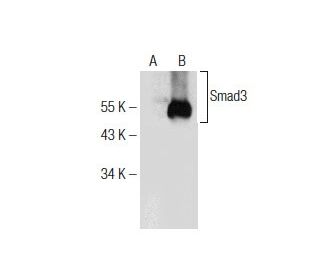
Smad3 (h): 293T Lysate: sc-116400
- human Smad3 transfected 293T lysate
- 100 µg protein in 200 µl SDS-PAGE buffer; suitable as Western Blotting control for Smad3 antibodies
- Suitable control antibody: Smad2/3 Antibody (E-1): sc-376928 is recommended as control antibody for monitoring of Smad3 expression knockdown by Western blotting or immunofluorescence
- should be stored at -20° C and repeated freezing and thawing should be minimized
- sample vial should be boiled once prior to use
- non-transfected control 293T lysate (sc-117752)

QUICK LINKS
Smad3 (h): 293T Lysate is derived from the human embryonic kidney 293T cell line, which has been genetically modified to express human Smad3. Smad3 is a crucial signal transducer in the transforming growth factor-beta (TGF-β) signaling pathway, playing a key role in regulating cell proliferation, differentiation, and apoptosis. The 293T cell line, known for its high transfection efficiency and protein expression capabilities, provides an ideal system for producing Smad3 lysates. In research, Smad3 (h): 293T Lysate is utilized to study the molecular mechanisms of TGF-β signaling. Upon TGF-β binding to its receptor, Smad3 is phosphorylated and forms a complex with Smad4. This complex translocates to the nucleus, where it regulates the transcription of target genes involved in various cellular processes. Researchers use this lysate in assays such as Western blotting, immunoprecipitation, and electrophoretic mobility shift assays (EMSAs) to analyze Smad3 expression, phosphorylation status, and DNA-binding activity. Additionally, Smad3 (h): 293T Lysate is employed in chromatin immunoprecipitation (ChIP) assays to explore Smad3's role in gene regulation and chromatin remodeling. The lysate is also valuable in studying the crosstalk between TGF-β signaling and other pathways, providing insights into how Smad3 mediates cellular responses to external signals. This research enhances our understanding of the complex regulatory networks governing cell behavior and contributes to the broader field of cellular signaling.
Ordering Information
| Product Name | Catalog # | UNIT | Price | Qty | FAVORITES | |
Smad3 (h): 293T Lysate | sc-116400 | 100 µg/200 µl | $236.00 |