
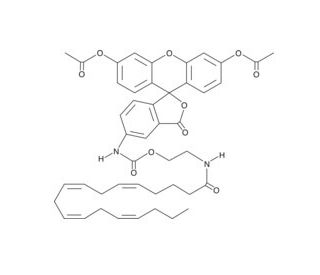

SKM 4-45-1 (CAS 290374-09-3)
QUICK LINKS
SKM 4-45-1, identified by the CAS number 290374-09-3, is a synthetic chemical compound that has garnered attention primarily for its role in biochemical research focused on elucidating cellular processes. This compound has been utilized notably in studies involving the modulation of protein interactions within cells. The structure of SKM 4-45-1 allows it to bind selectively to certain protein domains, which can disrupt the typical interactions these proteins engage in, providing a powerful tool for researchers to study the function of these proteins and their complexes in a controlled environment. By altering protein activity, SKM 4-45-1 helps in the understanding of signaling pathways and protein networks that are crucial for cellular function. This compound has proven particularly useful in the field of molecular biology and biochemistry where precise manipulation of protein-protein interactions is essential for dissecting complex biological systems. Researchers have exploited the properties of SKM 4-45-1 to investigate the underlying mechanisms governing cellular behavior, which has implications for understanding the fundamental aspects of cell biology and the molecular basis of various cellular functions. Through these research applications, SKM 4-45-1 contributes significantly to the scientific community′s ability to explore and manipulate the complex web of cellular interactions.
SKM 4-45-1 (CAS 290374-09-3) References
- Confocal microscopy and biochemical analysis reveal spatial and functional separation between anandamide uptake and hydrolysis in human keratinocytes. | Oddi, S., et al. 2005. Cell Mol Life Sci. 62: 386-95. PMID: 15723173
- Detergent-resistant membrane microdomains in the disposition of the lipid signaling molecule anandamide. | McFarland, MJ., et al. 2006. AAPS J. 8: E95-100. PMID: 16584138
- RNA interference-mediated knockdown of dynamin 2 reduces endocannabinoid uptake into neuronal dCAD cells. | McFarland, MJ., et al. 2008. Mol Pharmacol. 74: 101-8. PMID: 18436710
- Mechanisms for recycling and biosynthesis of endogenous cannabinoids anandamide and 2-arachidonylglycerol. | Placzek, EA., et al. 2008. J Neurochem. 107: 987-1000. PMID: 18778304
- Increased anandamide uptake by sensory neurons contributes to hyperalgesia in a model of cancer pain. | Khasabova, IA., et al. 2013. Neurobiol Dis. 58: 19-28. PMID: 23644187
- TRPV1 mediates cellular uptake of anandamide and thus promotes endothelial cell proliferation and network-formation. | Hofmann, NA., et al. 2014. Biol Open. 3: 1164-72. PMID: 25395667
- Visualization of Endocannabinoids in the Cell. | Oddi, S., et al. 2016. Methods Mol Biol. 1412: 277-82. PMID: 27245913
- Role of pannexin-1 in the cellular uptake, release and hydrolysis of anandamide by T84 colon cancer cells. | Alhouayek, M., et al. 2019. Sci Rep. 9: 7622. PMID: 31110238
- A new fluorescent analogue for the studies of anandamide transport in cell cultures. | Gretskaya, N. M., et al. 2014. Russian Journal of Bioorganic Chemistry. 40: 228-232.
Ordering Information
| Product Name | Catalog # | UNIT | Price | Qty | FAVORITES | |
SKM 4-45-1, 100 µg | sc-205509 | 100 µg | $56.00 | |||
SKM 4-45-1, 500 µg | sc-205509A | 500 µg | $255.00 |