
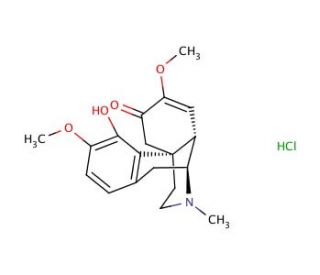

Sinomenine hydrochloride (CAS 6080-33-7)
QUICK LINKS
Sinomenine hydrochloride, an alkaloid derived from Sinomenium acutum, has attracted attention in scientific research for its diverse pharmacological properties. Its mechanism of action includes the inhibition of inflammatory mediators such as interleukin-1β (IL-1β), tumor necrosis factor-α (TNF-α), and prostaglandin E2 (PGE2). Additionally, sinomenine hydrochloride modulates immune responses by suppressing the activation of nuclear factor-kappa B (NF-κB) and mitogen-activated protein kinase (MAPK) signaling pathways, leading to a reduction in inflammatory cytokine production. Furthermore, it exhibits analgesic effects by interfering with the transmission of pain signals through inhibition of calcium channels and N-methyl-D-aspartate (NMDA) receptors. In research, sinomenine hydrochloride has been studied for its potential applications in various contexts, including exploring its effects on cellular signaling pathways and investigating its role in modulating cellular responses to external stimuli. Its multifaceted pharmacological profile makes sinomenine hydrochloride a valuable tool for understanding fundamental biological mechanisms and exploring potential applications in scientific research.
Sinomenine hydrochloride (CAS 6080-33-7) References
- High-throughput screening assay for the identification of compounds regulating self-renewal and differentiation in human embryonic stem cells. | Desbordes, SC., et al. 2008. Cell Stem Cell. 2: 602-12. PMID: 18522853
- Activation of opioid mu-receptor by sinomenine in cell and mice. | Wang, MH., et al. 2008. Neurosci Lett. 443: 209-12. PMID: 18692550
- Sinomenine hydrochloride protects against polymicrobial sepsis via autophagy. | Jiang, Y., et al. 2015. Int J Mol Sci. 16: 2559-73. PMID: 25625512
- Sinomenine hydrochloride inhibits cell survival in human hepatoma Huh7 cells. | Wang, Y., et al. 2018. Biomed Rep. 8: 510-516. PMID: 29971142
- Sinomenine hydrochloride inhibits the progression of plasma cell mastitis by regulating IL-6/JAK2/STAT3 pathway. | Liu, Y., et al. 2020. Int Immunopharmacol. 81: 106025. PMID: 31810886
- Sinomenine hydrochloride ameliorates dextran sulfate sodium-induced colitis in mice by modulating the gut microbiota composition whilst suppressing the activation of the NLRP3 inflammasome. | Zhou, Y., et al. 2021. Exp Ther Med. 22: 1287. PMID: 34630642
- Sinomenine Hydrochloride Ameliorates Fish Foodborne Enteritis via α7nAchR-Mediated Anti-Inflammatory Effect Whilst Altering Microbiota Composition. | Xie, J., et al. 2021. Front Immunol. 12: 766845. PMID: 34887862
- Sinomenine hydrochloride suppresses the stemness of breast cancer stem cells by inhibiting Wnt signaling pathway through down-regulation of WNT10B. | Li, X., et al. 2022. Pharmacol Res. 179: 106222. PMID: 35413424
- Sinomenine hydrochloride bidirectionally inhibits progression of tumor and autoimmune diseases by regulating AMPK pathway. | Li, RZ., et al. 2023. Phytomedicine. 114: 154751. PMID: 37004400
- Pharmacology of sinomenine, an anti-rheumatic alkaloid from Sinomenium acutum. | Yamasaki, H. 1976. Acta Med Okayama. 30: 1-20. PMID: 61710
Ordering Information
| Product Name | Catalog # | UNIT | Price | Qty | FAVORITES | |
Sinomenine hydrochloride, 25 mg | sc-280083 | 25 mg | $225.00 |