
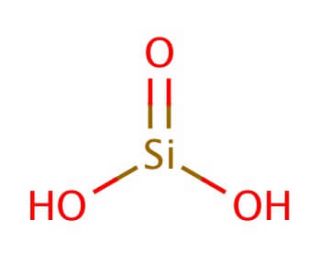

Silicic acid (CAS 1343-98-2)
QUICK LINKS
Silicic acid hydrate is a compound of interest primarily in the fields of materials science and geochemistry. It is frequently studied for its role in the formation of silica-based materials, such as glasses, ceramics, and zeolites. The compound′s ability to polymerize and form networks is critical in understanding the sol-gel process, a method used to produce advanced materials with controlled porosity and surface properties. In geochemical research, silicic acid hydrate is examined for its involvement in the biogeochemical cycling of silicon, as well as its contribution to the formation of natural silicate minerals and diatom frustules. Environmental scientists also utilize silicic acid hydrate to explore the mobility of silicon in soils and aquatic systems, and its interaction with other elements and minerals. Its role in regulating the bioavailability of silicon, an essential nutrient for certain organisms, is another aspect examined in ecological studies. Through these diverse applications, silicic acid hydrate provides insights into both synthetic processes and natural phenomena.
Silicic acid (CAS 1343-98-2) References
- Silicic acid: its gastrointestinal uptake and urinary excretion in man and effects on aluminium excretion. | Reffitt, DM., et al. 1999. J Inorg Biochem. 76: 141-7. PMID: 10612067
- The effect of different concentrations of silicic acid and silica dust on the biosynthesis of collagen in tissue cultures. | CHVAPIL, M. and HOLECKOVA, E. 1959. Br J Ind Med. 16: 286-9. PMID: 13810239
- A study of the alumina-silica gel adsorbent for the removal of silicic acid from geothermal water: increase in adsorption capacity of the adsorbent due to formation of amorphous aluminosilicate by adsorption of silicic acid. | Yokoyama, T., et al. 2002. J Colloid Interface Sci. 252: 1-5. PMID: 16290755
- Sorption of selenium(IV) onto magnetite in the presence of silicic acid. | Jordan, N., et al. 2009. J Colloid Interface Sci. 329: 17-23. PMID: 18947836
- Competition between selenium (IV) and silicic acid on the hematite surface. | Jordan, N., et al. 2009. Chemosphere. 75: 129-34. PMID: 19110295
- Glacial silicic acid concentrations in the Southern Ocean. | Ellwood, MJ., et al. 2010. Science. 330: 1088-91. PMID: 20966217
- Silicic acid in drinking water prevents age-related alterations in the endothelium-dependent vascular relaxation modulating eNOS and AQP1 expression in experimental mice: an immunohistochemical study. | Buffoli, B., et al. 2013. Acta Histochem. 115: 418-24. PMID: 23177919
- Silicic-acid uptake in diatoms studied with [(68)Ge]germanic acid as tracer. | Azam, F. 1974. Planta. 121: 205-12. PMID: 24442800
- The effect of silicic acid on calcium phosphate precipitation. | Damen, JJ. and ten Cate, JM. 1989. J Dent Res. 68: 1355-9. PMID: 2550533
- Interrelationship between hemolysis and lipid peroxidation of human erythrocytes induced by silicic acid and silicate dusts. | Singh, SV. and Rahman, Q. 1987. J Appl Toxicol. 7: 91-6. PMID: 3040843
- Silicic acid limitation drives bloom termination and potential carbon sequestration in an Arctic bloom. | Krause, JW., et al. 2019. Sci Rep. 9: 8149. PMID: 31148569
- Colloidal Dynamics of Freshly Formed Iron Oxides under the Influence of Silicic Acid. | Dam, TTN., et al. 2019. J Environ Qual. 48: 670-676. PMID: 31180432
- Structural Basis for Silicic Acid Uptake by Higher Plants. | van den Berg, B., et al. 2021. J Mol Biol. 433: 167226. PMID: 34487790
- Elevated ozone phytotoxicity ameliorations in mung bean {Vigna radiata (L.) Wilczek} by foliar nebulization of silicic acid and ascorbic acid. | Shahzadi, E., et al. 2022. Environ Sci Pollut Res Int. 29: 69680-69690. PMID: 35576036
- Computational modelling of diatom silicic acid transporters predicts a conserved fold with implications for their function and evolution. | Knight, MJ., et al. 2023. Biochim Biophys Acta Biomembr. 1865: 184056. PMID: 36191629
Ordering Information
| Product Name | Catalog # | UNIT | Price | Qty | FAVORITES | |
Silicic acid, 100 g | sc-229290 | 100 g | $155.00 | |||
Silicic acid, 250 g | sc-229290A | 250 g | $260.00 |