
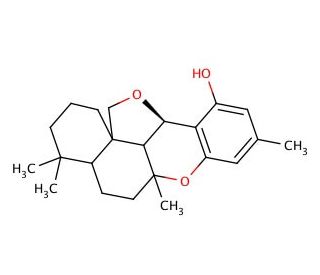

Siccanin (CAS 22733-60-4)
QUICK LINKS
Siccanin is a distinct organic compound classified as a mycotoxin, originally isolated from the fungus Helminthosporium siccans. It belongs to a group of chemicals known as polyketides, which are notable for their complex molecular structures and diverse biological activities. The primary mechanism of action of siccanin involves the inhibition of mitochondrial electron transport, specifically at Complex III (ubiquinol-cytochrome c reductase). By blocking this critical step in the electron transport chain, siccanin disrupts ATP synthesis, leading to a reduction in cellular energy production. This specific mode of action makes siccanin a useful tool in biochemical and physiological research, particularly in studies aimed at understanding the intricacies of mitochondrial function and its impact on cellular metabolism. Researchers have utilized siccanin to experimentally induce conditions of impaired mitochondrial function to study cellular responses such as apoptosis, reactive oxygen species production, and metabolic adaptation. Furthermore, its role in inhibiting fungal growth has also made it a subject of interest in the study of fungal biology and the development of antifungal strategies, especially against pathogenic fungi that affect crops. Through such research applications, siccanin contributes to broader scientific understanding across multiple fields, including bioenergetics and agricultural science.
Siccanin (CAS 22733-60-4) References
- From General to Specific: Can Pseudomonas Primary Metabolism Be Exploited for Narrow-Spectrum Antibiotics? | Shapiro, JA., et al. 2019. Chembiochem. 20: 34-39. PMID: 30088315
- Novel Characteristics of Mitochondrial Electron Transport Chain from Eimeria tenella. | Matsubayashi, M., et al. 2019. Genes (Basel). 10: PMID: 30626105
- Mitochondria as a Potential Target for the Development of Prophylactic and Therapeutic Drugs against Schistosoma mansoni Infection. | Talaam, KK., et al. 2021. Antimicrob Agents Chemother. 65: e0041821. PMID: 34339272
- Siccanin Is a Dual-Target Inhibitor of Plasmodium falciparum Mitochondrial Complex II and Complex III. | Komatsuya, K., et al. 2022. Pharmaceuticals (Basel). 15: PMID: 35890202
- Bioactive Metabolite Production in the Genus Pyrenophora (Pleosporaceae, Pleosporales). | Masi, M., et al. 2022. Toxins (Basel). 14: PMID: 36136526
- Structure-Based Design of Promysalin Analogues to Overcome Mechanisms of Bacterial Resistance. | Mahoney, AR., et al. 2023. ACS Omega. 8: 12558-12564. PMID: 37033834
- Complex II Biology in Aging, Health, and Disease. | Goetzman, E., et al. 2023. Antioxidants (Basel). 12: PMID: 37508015
- Special Issue 'Drug Candidates for the Treatment of Infectious Diseases'. | Man Chin, C. and Dos Santos, JL. 2023. Pharmaceuticals (Basel). 16: PMID: 37765065
- Identification of complex III, NQR, and SDH as primary bioenergetic enzymes during the stationary phase of Pseudomonas aeruginosa cultured in urine-like conditions. | Hu, Y., et al. 2024. Front Microbiol. 15: 1347466. PMID: 38468849
- Identification of a family of species-selective complex I inhibitors as potential anthelmintics. | Davie, T., et al. 2024. Nat Commun. 15: 3367. PMID: 38719808
Ordering Information
| Product Name | Catalog # | UNIT | Price | Qty | FAVORITES | |
Siccanin, 1 mg | sc-391688 | 1 mg | $292.00 |