
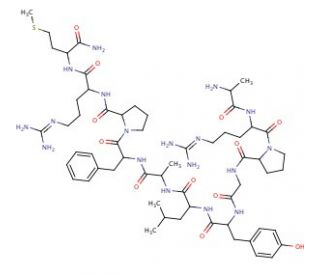

SCPA (CAS 98035-79-1)
QUICK LINKS
SCPA, or S-carboxymethyl-L-cysteine p-nitroanilide, is a specialized chemical compound primarily used in biochemical research for its role as a substrate in enzymatic assays, particularly those involving proteases. SCPA serves as an artificial substrate to study the specificity and kinetics of certain proteases, such as carboxypeptidase A, which are crucial for understanding protein digestion and other related enzymatic processes. The mechanism of action of SCPA in these assays involves its cleavage by the enzyme at specific sites, with the release of a measurable product, p-nitroaniline, which can be detected spectrophotometrically due to its yellow color. This measurable change provides a quantifiable means of assessing enzyme activity, specificity, and inhibition, which is invaluable in enzymology and the development of enzyme-based assays. Researchers utilize SCPA to explore enzyme catalysis mechanisms, inhibitor screening, and to characterize novel proteases from different biological sources. This use of SCPA in research not only helps in elucidating fundamental enzymatic processes but also aids in the bioengineering field where understanding the dynamics of enzyme-substrate interactions is essential for designing more efficient enzymes.
SCPA (CAS 98035-79-1) References
- Differential peptide expression in the central nervous system of the land snail Theba pisana, between active and aestivated. | Adamson, KJ., et al. 2016. Peptides. 80: 61-71. PMID: 26303007
- Modulation of calcium current and diverse K+ currents in identified Hermissenda neurons by small cardioactive peptide B. | Acosta-Urquidi, J. 1988. J Neurosci. 8: 1694-703. PMID: 3367217
- Sequence of small cardioactive peptide A: a second member of a class of neuropeptides in Aplysia. | Lloyd, PE., et al. 1987. Peptides. 8: 179-84. PMID: 3575150
- The presence and location of small cardioactive‐like peptides in larvae of C rassostrea virginica | Ellis, I., & Kempf, S. C. 2011. Invertebrate Biology. 130(3): 251-263.
Ordering Information
| Product Name | Catalog # | UNIT | Price | Qty | FAVORITES | |
SCPA, 1 mg | sc-394357 | 1 mg | $120.00 |