
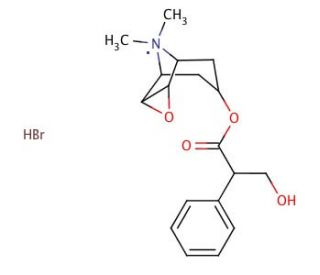

(−)-Scopolamine methyl bromide (CAS 155-41-9)
QUICK LINKS
(−)-Scopolamine methyl bromide is primarily utilized in biochemical research where it acts as a ligand to study muscarinic acetylcholine receptor interactions within various biological systems. Its structure allows for specific binding to muscarinic receptors, enabling researchers to explore receptor dynamics and signaling pathways without the compound penetrating the central nervous system due to its quaternary ammonium group. This property makes it particularly useful for examining the peripheral actions of muscarinic receptors. In receptor binding assays, it functions as a tool to help determine receptor density and affinity in a range of tissue types. Moreover, in the field of molecular pharmacology, (−)-scopolamine methyl bromide is instrumental in characterizing the pharmacological profiles of other compounds that interact with muscarinic receptors, facilitating the understanding of their mechanism of action.
(−)-Scopolamine methyl bromide (CAS 155-41-9) References
- Effects of scopolamine and its quaternary analogue in the murine elevated plus-maze test of anxiety. | Rodgers, RJ. and Cole, JC. 1995. Behav Pharmacol. 6: 283-289. PMID: 11224337
- A chronic implant to record electroretinogram, visual evoked potentials and oscillatory potentials in awake, freely moving rats for pharmacological studies. | Guarino, I., et al. 2004. Neural Plast. 11: 241-50. PMID: 15656271
- Hemodynamic consequences of chronic parasympathetic blockade with a peripheral muscarinic antagonist. | Ayer, A., et al. 2007. Am J Physiol Heart Circ Physiol. 293: H1265-72. PMID: 17496215
- Muscarinic receptor antagonism of the nucleus accumbens core causes avoidance to flavor and spatial cues. | Pratt, WE., et al. 2007. Behav Neurosci. 121: 1215-23. PMID: 18085875
- Nucleus accumbens acetylcholine and food intake: decreased muscarinic tone reduces feeding but not food-seeking. | Pratt, WE. and Blackstone, K. 2009. Behav Brain Res. 198: 252-7. PMID: 19041901
- Scopolamine differentially disrupts the behavior of male and female Wistar rats in a delayed nonmatching to position procedure. | van Hest, A., et al. 1990. Pharmacol Biochem Behav. 35: 903-9. PMID: 2345764
- Local and generalized sensitization of thermally evoked defensive behavior in caterpillars. | Mukherjee, R. and Trimmer, BA. 2020. J Comp Neurol. 528: 805-815. PMID: 31644815
- Comparative profile of refractory status epilepticus models following exposure of cholinergic agents pilocarpine, DFP, and soman. | Reddy, DS., et al. 2021. Neuropharmacology. 191: 108571. PMID: 33878303
- Neuropilin-2 Signaling Modulates Mossy Fiber Sprouting by Regulating Axon Collateral Formation Through CRMP2 in a Rat Model of Epilepsy. | Li, Y., et al. 2022. Mol Neurobiol. 59: 6817-6833. PMID: 36044155
- Dentate gyrus and olfactory bulb responses to olfactory and noxious stimulation in urethane anaesthetized rats. | Heale, VR. and Vanderwolf, CH. 1994. Brain Res. 652: 235-42. PMID: 7953735
- Effect of thyrotropin-releasing hormone on pentobarbitone-induced sleep in rats: continuous treatment with a sustained release injectable formulation. | Hashimoto, T., et al. 1993. J Pharm Pharmacol. 45: 94-7. PMID: 8095539
- Disruption of trace conditioning of the nictitating membrane response in rabbits by central cholinergic blockade. | Kaneko, T. and Thompson, RF. 1997. Psychopharmacology (Berl). 131: 161-6. PMID: 9201804
- Absence of central cholinergic deficits in ApoE knockout mice. | Anderson, R. and Higgins, GA. 1997. Psychopharmacology (Berl). 132: 135-44. PMID: 9266610
Ordering Information
| Product Name | Catalog # | UNIT | Price | Qty | FAVORITES | |
(−)-Scopolamine methyl bromide, 1 g | sc-253545 | 1 g | $80.00 |