
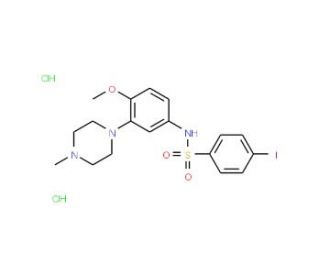

SB-258585 dihydrochloride
QUICK LINKS
SB-258585 dihydrochloride is a selective and potent antagonist of the orexin OX1 receptor. It functions by binding to the OX1 receptor and inhibiting the activation of this receptor by its endogenous ligands, orexin-A and orexin-B. SB-258585 dihydrochloride′s mode involves blocking the signaling pathway downstream of the OX1 receptor, thereby preventing the physiological effects mediated by this receptor. Targeting the OX1 receptor, SB-258585 dihydrochloride can be used to investigate the role of orexin signaling in various physiological and pathological processes. Its ability to selectively block the OX1 receptor makes for studying the specific functions of this receptor in cellular and molecular processes. In experimental applications, SB-258585 dihydrochloride′s function as an OX1 receptor antagonist allows researchers to the involvement of orexin signaling in the regulation of sleep-wake cycles, energy homeostasis, and other physiological functions.
SB-258585 dihydrochloride References
- Characterization of [(125)I]-SB-258585 binding to human recombinant and native 5-HT(6) receptors in rat, pig and human brain tissue. | Hirst, WD., et al. 2000. Br J Pharmacol. 130: 1597-605. PMID: 10928963
- SB-271046 (SmithKline Beecham). | Miguel-Hidalgo, JJ. 2001. Curr Opin Investig Drugs. 2: 118-22. PMID: 11527003
- Anxiolytic-like and antidepressant-like effects produced by the selective 5-HT6 receptor antagonist SB-258585 after intrahippocampal administration to rats. | Wesołowska, A., et al. 2007. Behav Pharmacol. 18: 439-46. PMID: 17762512
- Role of peripheral and spinal 5-HT6 receptors according to the rat formalin test. | Castañeda-Corral, G., et al. 2009. Neuroscience. 162: 444-52. PMID: 19422883
- Serotonergic modulation of extrapyramidal motor disorders in mice and rats: role of striatal 5-HT3 and 5-HT6 receptors. | Ohno, Y., et al. 2011. Neuropharmacology. 60: 201-8. PMID: 20813116
- Role of peripheral 5-HT(4), 5-HT(6), and 5-HT(7) receptors in development and maintenance of secondary mechanical allodynia and hyperalgesia. | Godínez-Chaparro, B., et al. 2011. Pain. 152: 687-697. PMID: 21239110
- Effects of 5-HT6 antagonists, Ro-4368554 and SB-258585, in tests used for the detection of cognitive enhancement and antipsychotic-like activity. | Gravius, A., et al. 2011. Behav Pharmacol. 22: 122-35. PMID: 21301322
- Modulation of antipsychotic-induced extrapyramidal side effects by medications for mood disorders. | Tatara, A., et al. 2012. Prog Neuropsychopharmacol Biol Psychiatry. 38: 252-9. PMID: 22542492
- Secondary mechanical allodynia and hyperalgesia depend on descending facilitation mediated by spinal 5-HT₄, 5-HT₆ and 5-HT₇ receptors. | Godínez-Chaparro, B., et al. 2012. Neuroscience. 222: 379-91. PMID: 22796074
- Interaction between anti-Alzheimer and antipsychotic drugs in modulating extrapyramidal motor disorders in mice. | Shimizu, S., et al. 2015. J Pharmacol Sci. 127: 439-45. PMID: 25850380
- Spinal 5-HT4 and 5-HT6 receptors contribute to the maintenance of neuropathic pain in rats. | Pineda-Farias, JB., et al. 2017. Pharmacol Rep. 69: 916-923. PMID: 28628851
- Serotonergic modulation of nicotine-induced kinetic tremor in mice. | Kunisawa, N., et al. 2017. J Pharmacol Sci. 134: 131-138. PMID: 28647281
- Spinal Serotonin and 5HT6 Receptor Levels During Development of Neuropathy and Influence of Blockade of these Receptors on Thermal Hyperalgesia in Diabetic Mice. | Sari, CC., et al. 2019. Drug Res (Stuttg). 69: 428-433. PMID: 30609433
- Serotonin type 6 receptor antagonist attenuates the impairment of long-term potentiation and memory induced by Abeta. | Shahidi, S., et al. 2019. Behav Brain Res. 364: 205-212. PMID: 30735758
- The distribution of 5-HT6 receptors in rat brain: an autoradiographic binding study using the radiolabelled 5-HT6 receptor antagonist [125I]SB-258585 | Jennifer C. Roberts a, Charlie Reavill a, Simon Z. East b, Paul J. Harrison b, Sara Patel a 1, Carol Routledge c, Ronald A. Leslie c. 2002. Brain Research. 934: 49-57.
Ordering Information
| Product Name | Catalog # | UNIT | Price | Qty | FAVORITES | |
SB-258585 dihydrochloride, 10 mg | sc-301789 | 10 mg | $185.00 |