
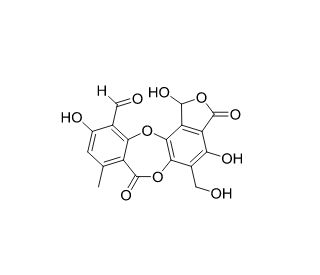

Molekülstruktur von Salazinic acid, CAS-Nummer: 521-39-1
Salazinic acid (CAS 521-39-1)
Alternative Namen:
Salacinic acid; Parmatic acid; Saxatilic acid
Anwendungen:
Salazinic acid ist ein Metabolit mit antioxidativen Eigenschaften.
CAS Nummer:
521-39-1
Reinheit:
≥95%
Molekulargewicht:
388.3
Summenformel:
C18H12O10
For Research Use Only. Not Intended for Diagnostic or Therapeutic Use.
* Refer to Certificate of Analysis for lot specific data.
Direktverknüpfungen
Bestellinformation
Beschreibung
Hintergrundinformationen
Sicherheitshinweis
SDS (SDB) & Analysenzertifikate
Salazinsäure, ein Depsidon-Lichtmimetikum, das in P. sulcata entdeckt wurde, zeigt bemerkenswerte Eigenschaften. In-vitro-Studien haben ihre Wirksamkeit gegen verschiedene Mikroorganismen mit minimalen Hemmungskonzentrationen (MHK) im Bereich von 3,9 bis 30,8 mM gezeigt. Darüber hinaus zeigt Salazinsäure zytotoxische Effekte auf MM98, A431 und HaCaT-Zellen, wie durch Kristallviolett-Assays (mit EC50s von 159, 2.870 und 48 μM, bzw.) und Neutralrot-Aufnahme-Assays (mit EC50s von 1.925, 1.913 und 907 μM, bzw.) belegt wird. Bemerkenswerterweise beschleunigt sie bei einer Konzentration von 30 μM die Wundschließung in scratch-verletzten HaCaT-Monolayern und erhöht die HaCaT-Zellmigration in Transwell-Assays.
Salazinic acid (CAS 521-39-1) Literaturhinweise
- Antimikrobielle Aktivität von Extrakten aus der Flechte Parmelia sulcata und ihrem Salazinsäure-Bestandteil. | Candan, M., et al. 2007. Z Naturforsch C J Biosci. 62: 619-21. PMID: 17913083
- Ökologische Bedeutung der Variation der Sekundärmetaboliten in Parmelioid-Flechten in Abhängigkeit von der Höhenlage. | Shukla, V., et al. 2016. Environ Sci Pollut Res Int. 23: 1391-7. PMID: 26370809
- Potenzial von Flechtenverbindungen als antidiabetische Wirkstoffe mit antioxidativen Eigenschaften: Eine Übersicht. | Thadhani, VM. and Karunaratne, V. 2017. Oxid Med Cell Longev. 2017: 2079697. PMID: 28491237
- Aus Flechten gewonnene Kapernsäure und Physodiksäure hemmen die Wnt-Signalübertragung in Darmkrebszellen. | Paluszczak, J., et al. 2018. Mol Cell Biochem. 441: 109-124. PMID: 28887754
- Von Salazinsäure abgeleitete Depsidone und Diphenylether mit α-Glucosidase hemmender Wirkung aus der Flechte Parmotrema dilatatum. | Devi, AP., et al. 2020. Planta Med. 86: 1216-1224. PMID: 32819010
- Flechten-Depsidone von biologischem Interesse. | Ureña-Vacas, I., et al. 2022. Planta Med. 88: 855-880. PMID: 34034351
- Ein Überblick über die krebshemmenden und verwandten Eigenschaften von Flechtenextrakten und Metaboliten. | Tripathi, AH., et al. 2022. Anticancer Agents Med Chem. 22: 115-142. PMID: 34225637
- Aus Flechten gewonnene Depside und Depsidone modulieren die Nrf2-, NF-κB- und STAT3-Signalwege in kolorektalen Krebszellen. | Papierska, K., et al. 2021. Molecules. 26: PMID: 34443375
- Biologische Auswirkungen von Gyrophorsäure und anderen aus Flechten gewonnenen Metaboliten auf Zellproliferation, Apoptose und Zellsignalwege. | Mohammadi, M., et al. 2022. Chem Biol Interact. 351: 109768. PMID: 34864007
- Acidi protocetrarici e salazinici come potenziali inibitori della proteasi 3CL della SARS-CoV-2: Caratterizzazione biochimica, citotossica e computazionale dei depsidoni come inattivatori a legame lento. | Fagnani, L., et al. 2022. Pharmaceuticals (Basel). 15: PMID: 35745633
- Histologische Auswertung der Leber von Mäusen mit Sarkom-180, die mit Salazinsäure behandelt wurden. | Lira, MADC., et al. 2023. An Acad Bras Cienc. 95: e20200455. PMID: 37018833
- Bewertung des zytotoxischen/Antitumor-Potenzials und In-Silico-Studie der aus Parmotrema concurrens isolierten Salazinsäure. | de Lira, MADC., et al. 2023. Anticancer Agents Med Chem.. PMID: 37032502
- Salazinsäure mildert die männliche sexuelle Dysfunktion und die oxidative Schädigung des Hodens bei diabetischen Albino-Ratten, die durch Streptozotocin verursacht wurden. | Killari, KN., et al. 2023. RSC Adv. 13: 12991-13005. PMID: 37124014
Bestellinformation
| Produkt | Katalog # | EINHEIT | Preis | ANZAHL | Favoriten | |
Salazinic acid, 1 mg | sc-506286 | 1 mg | $153.00 |