
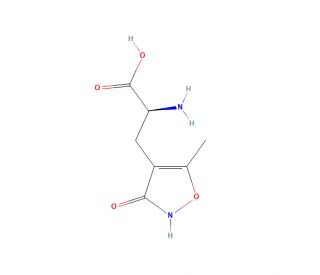

Molecular structure of (S)-a-Amino-3-hydroxy-5-methyl-4-isoxazolepropionic acid, CAS Number: 83643-88-3
(S)-a-Amino-3-hydroxy-5-methyl-4-isoxazolepropionic acid (CAS 83643-88-3)
Alternate Names:
(S)-AMPA; AMQ; glutamate-AMPA
Application:
(S)-a-Amino-3-hydroxy-5-methyl-4-isoxazolepropionic acid is an active isomer of AMPA with no NMDAR activity
CAS Number:
83643-88-3
Molecular Weight:
186.17
Molecular Formula:
C7H10N2O4
For Research Use Only. Not Intended for Diagnostic or Therapeutic Use.
* Refer to Certificate of Analysis for lot specific data.
QUICK LINKS
Ordering Information
Description
Technical Information
Safety Information
SDS & Certificate of Analysis
(S)-a-Amino-3-hydroxy-5-methyl-4-isoxazolepropionic Acid is an active enantiomer of AMPA that induces apoptotic cell death in cortical neurons. Does not exhibit any affinity for NMDA receptors.
(S)-a-Amino-3-hydroxy-5-methyl-4-isoxazolepropionic acid (CAS 83643-88-3) References
- (S)-AMPA inhibits electrically evoked calcitonin gene-related peptide (CGRP) release from the rat dorsal horn: reversal by cannabinoid receptor antagonist SR141716A. | Brooks, JW., et al. 2004. Neurosci Lett. 372: 85-8. PMID: 15531093
- Molecular mechanisms of neurite growth with AMPA receptor potentiation. | Voss, OP., et al. 2007. Neuropharmacology. 52: 590-7. PMID: 17101156
- S18986: a positive modulator of AMPA-receptors enhances (S)-AMPA-mediated BDNF mRNA and protein expression in rat primary cortical neuronal cultures. | Lockhart, BP., et al. 2007. Eur J Pharmacol. 561: 23-31. PMID: 17331496
- Hippocampal AMPA autoreceptors positively coupled to NMDA autoreceptors traffic in a constitutive manner and undergo adaptative changes following enriched environment training. | Summa, M., et al. 2011. Neuropharmacology. 61: 1282-90. PMID: 21820454
- Involvement of prefrontal AMPA receptors in encounter stimulation-induced hyperactivity in isolation-reared mice. | Araki, R., et al. 2014. Int J Neuropsychopharmacol. 17: 883-93. PMID: 24405605
- AMPA receptor desensitization is the determinant of AMPA receptor mediated excitotoxicity in purified retinal ganglion cells. | Park, YH., et al. 2015. Exp Eye Res. 132: 136-50. PMID: 25643624
- The role of the AMPA receptor and 5-HT(3) receptor on aggressive behavior and depressive-like symptoms in chronic social isolation-reared mice. | Shimizu, K., et al. 2016. Physiol Behav. 153: 70-83. PMID: 26522741
- Involvement of neuronal and glial activities in control of the extracellular d-serine concentrations by the AMPA glutamate receptor in the mouse medial prefrontal cortex. | Ishiwata, S., et al. 2018. Neurochem Int. 119: 120-125. PMID: 28966065
- Enhanced AMPA receptor-mediated excitatory transmission in the rodent rostromedial tegmental nucleus following lesion of the nigrostriatal pathway. | Chang, Y., et al. 2019. Neurochem Int. 122: 85-93. PMID: 30448565
- Activation of AMPA Receptors in the Lateral Habenula Produces Anxiolytic Effects in a Rat Model of Parkinson's Disease. | Zhang, J., et al. 2022. Front Pharmacol. 13: 821975. PMID: 35145415
- Molecular pharmacology of the AMPA agonist, (S)-2-amino-3-(3-hydroxy-5-phenyl-4-isoxazolyl)propionic acid [(S)-APPA] and the AMPA antagonist, (R)-APPA. | Ebert, B., et al. 1994. Neurochem Int. 24: 507-15. PMID: 7526921
- Apoptosis induced via AMPA-selective glutamate receptors in cultured murine cortical neurons. | Larm, JA., et al. 1997. J Neurochem. 69: 617-22. PMID: 9231719
Activator of:
GluR.Ordering Information
| Product Name | Catalog # | UNIT | Price | Qty | FAVORITES | |
(S)-a-Amino-3-hydroxy-5-methyl-4-isoxazolepropionic acid, 5 mg | sc-203250 | 5 mg | $162.00 | |||
(S)-a-Amino-3-hydroxy-5-methyl-4-isoxazolepropionic acid, 10 mg | sc-203250A | 10 mg | $281.00 | |||
(S)-a-Amino-3-hydroxy-5-methyl-4-isoxazolepropionic acid, 50 mg | sc-203250B | 50 mg | $988.00 | |||
(S)-a-Amino-3-hydroxy-5-methyl-4-isoxazolepropionic acid, 100 mg | sc-203250C | 100 mg | $1457.00 | |||
(S)-a-Amino-3-hydroxy-5-methyl-4-isoxazolepropionic acid, 1 g | sc-203250D | 1 g | $11965.00 |