
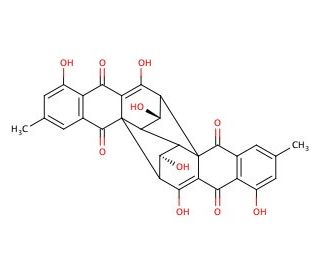

(−)-Rugulosin (CAS 21884-45-7)
QUICK LINKS
(−)-Rugulosin is a naturally occurring anthraquinone derivative, notable for its complex structure and diverse biological activities. Its mechanism of action primarily involves intercalation into DNA, where it binds to the DNA helix and disrupts the replication and transcription processes. This intercalative ability makes (−)-rugulosin a valuable compound for studying the interactions between small molecules and nucleic acids. In research, (−)-rugulosin has been extensively used to investigate its effects on cellular processes, particularly those related to DNA damage and repair mechanisms. It serves as a model compound in studies exploring the molecular basis of DNA binding and the resultant biological effects. Recent research has focused on the biosynthetic pathways of (−)-rugulosin in fungi, providing insights into the enzymatic processes and genetic regulation involved in its production. These studies employ techniques such as gene knockout and overexpression, alongside advanced chromatographic and spectroscopic methods, to explain the steps of its biosynthesis. Additionally, (−)-rugulosin has been used in ecological studies to understand its role as a fungal secondary metabolite, particularly in the interactions between fungi and their environment. Analytical techniques such as NMR spectroscopy, mass spectrometry, and X-ray crystallography have been pivotal in characterizing the structure of (−)-rugulosin and its binding interactions with biological macromolecules. Overall, (−)-rugulosin remains a significant compound in biochemical and ecological research, contributing to the understanding of DNA intercalation and fungal secondary metabolism.
(−)-Rugulosin (CAS 21884-45-7) References
- Chemoenzymatic, biomimetic total synthesis of (-)-rugulosin B, C and rugulin analogues and their biosynthetic implications. | Mondal, A., et al. 2020. Chem Commun (Camb). 56: 3337-3340. PMID: 32090214
- Anthrol reductases: discovery, role in biosynthesis and applications in natural product syntheses. | Rajput, A., et al. 2023. Nat Prod Rep. 40: 1672-1686. PMID: 37475701
- Concise chemoenzymatic total synthesis of (−)-rubroskyrin,(−)-deoxyrubroskyrin (−)-luteoskyrin, and (−)-deoxyluteoskyrin[J]. | Mondal A, Saha N, Husain S M. 2022,. Tetrahedron Chem,. 3:: 100030.
Ordering Information
| Product Name | Catalog # | UNIT | Price | Qty | FAVORITES | |
(−)-Rugulosin, 1 mg | sc-391698 | 1 mg | $208.00 |