
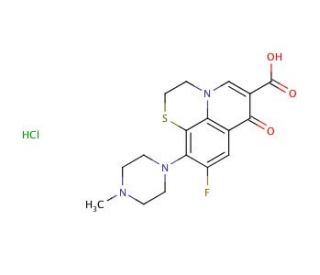

Rufloxacin Hydrochloride (CAS 106017-08-7)
See product citations (1)
QUICK LINKS
Rufloxacin hydrochloride is a antibacterial agent that functions by inhibiting the bacterial DNA gyrase enzyme. This inhibition prevents the supercoiling of DNA, leading to the disruption of bacterial DNA synthesis and ultimately causing bacterial cell death. Rufloxacin hydrochloride specifically targets the A subunit of DNA gyrase, interfering with its ability to break and reseal DNA strands during replication. By disrupting this enzymatic activity, Rufloxacin hydrochloride effectively inhibits the growth and proliferation of susceptible bacterial pathogens. This mechanism of action makes Rufloxacin hydrochloride potent for studying bacterial DNA replication and transcription processes in experimental applications.
Rufloxacin Hydrochloride (CAS 106017-08-7) References
- Molecular mechanisms of photosensitization induced by drugs. XII. Photochemistry and photosensitization of rufloxacin: an unusual photodegradation path for the antibacterials containing a fluoroquinolone-like chromophore. | Condorelli, G., et al. 1999. Photochem Photobiol. 70: 280-6. PMID: 10483356
- Penetration of rufloxacin into the cerebrospinal fluid in patients with inflamed and uninflamed meninges. | Moretti, MV., et al. 2000. Antimicrob Agents Chemother. 44: 73-7. PMID: 10602726
- Optimization and validation of a CZE method for rufloxacin hydrochloride determination in coated tablets. | Furlanetto, S., et al. 2002. J Pharm Biomed Anal. 28: 1161-71. PMID: 12049980
- The in-vitro activity of two new quinolones: rufloxacin and MF 961. | Wise, R., et al. 1992. J Antimicrob Chemother. 29: 649-60. PMID: 1324239
- Effect of rufloxacin on in-vitro proliferation and differentiation of human mononuclear cells. | Gollapudi, S., et al. 1992. J Antimicrob Chemother. 29: 669-76. PMID: 1324240
- Multiple-dose pharmacokinetics and safety of rufloxacin in normal volunteers. | Kisicki, JC., et al. 1992. Antimicrob Agents Chemother. 36: 1296-301. PMID: 1329618
- Rufloxacin-induced photosensitization in yeast. | Catalfo, A., et al. 2007. Photochem Photobiol Sci. 6: 181-9. PMID: 17277842
- Quinolonecarboxylic acids. 2. Synthesis and antibacterial evaluation of 7-oxo-2,3-dihydro-7H-pyrido[1,2,3-de][1,4]benzothiazine-6-carboxylic acids. | Cecchetti, V., et al. 1987. J Med Chem. 30: 465-73. PMID: 3820216
- Double-blind, comparative study of rufloxacin once daily versus amoxicillin three times a day in treatment of outpatients with exacerbations of chronic bronchitis. | Klietmann, W., et al. 1993. Antimicrob Agents Chemother. 37: 2298-306. PMID: 8285609
- Rufloxacin once daily versus ofloxacin twice daily for treatment of complicated cystitis and upper urinary tract infections. Italian Multicentre UTI Rufloxacin Group. | Mattina, R., et al. 1993. Infection. 21: 106-11. PMID: 8387963
- Comparison of the mechanism of action and resistance of two new fluoroquinolones, rufloxacin and MF961 with those of ofloxacin and fleroxacin in gram-negative and gram-positive bacteria. | Piddock, LJ., et al. 1993. J Antimicrob Chemother. 31: 855-63. PMID: 8395493
Ordering Information
| Product Name | Catalog # | UNIT | Price | Qty | FAVORITES | |
Rufloxacin Hydrochloride, 50 mg | sc-202326 | 50 mg | $52.00 | |||
Rufloxacin Hydrochloride, 250 mg | sc-202326A | 250 mg | $208.00 |