
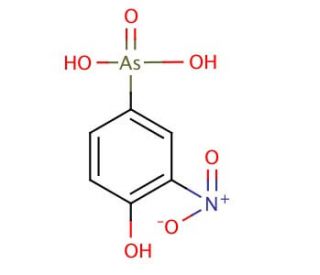

Roxarson (CAS 121-19-7)
QUICK LINKS
Roxarson is a chemical agent utilized in a range of applications for fighting microbes. It acts by inhibiting the synthesis of bacterial proteins, aiming at the ribosomes within the bacterial cells. This disruption of protein synthesis ultimately leads to the inhibition of bacterial growth and reproduction. Roxarson achieves this by binding to the ribosomal subunit, preventing the attachment of aminoacyl-tRNA and the elongation of the peptide chain during protein synthesis. This interference with bacterial protein production effectively hinders the ability of the bacteria to proliferate and cause infection. In experimental applications, Roxarson′s mechanism of action involves disrupting the normal functioning of bacterial ribosomes.
Roxarson (CAS 121-19-7) References
- Environmental concerns of roxarsone in broiler poultry feed and litter in Maryland, USA. | Fisher, DJ., et al. 2015. Environ Sci Technol. 49: 1999-2012. PMID: 25608233
- Organoarsenic Roxarsone Promotes Angiogenesis In Vivo. | Zhang, Y., et al. 2016. Basic Clin Pharmacol Toxicol. 118: 259-70. PMID: 26450128
- Roxarsone induces angiogenesis via PI3K/Akt signaling. | Wang, Y., et al. 2016. Cell Biosci. 6: 54. PMID: 27708768
- Response of microbial communities to roxarsone under different culture conditions. | Liu, Y., et al. 2017. Can J Microbiol. 63: 661-670. PMID: 28177786
- Response of soil microbial communities to roxarsone pollution along a concentration gradient. | Liu, Y., et al. 2017. J Environ Sci Health A Tox Hazard Subst Environ Eng. 52: 819-827. PMID: 28276888
- Tumor-promoting and pro-angiogenic effects of roxarsone via VEGFR2/PLCγ/PKC signaling. | Pang, Y., et al. 2018. Chem Biol Interact. 292: 110-120. PMID: 30028964
- Identification of an anaerobic bacterial consortium that degrades roxarsone. | Li, Y., et al. 2020. Microbiologyopen. 9: e1003. PMID: 32053294
- Simultaneous roxarsone photocatalytic degradation and arsenic adsorption removal by TiO2/FeOOH hybrid. | Fu, W., et al. 2020. Environ Sci Pollut Res Int. 27: 18434-18442. PMID: 32185737
- Degradation of roxarsone in UV-based advanced oxidation processes: A comparative study. | Chen, L., et al. 2021. J Hazard Mater. 410: 124558. PMID: 33223319
- Enhancing Roxarsone Degradation and In Situ Arsenic Immobilization Using a Sulfate-Mediated Bioelectrochemical System. | Tang, R., et al. 2021. Environ Sci Technol. 55: 393-401. PMID: 33301302
- Roxarsone Promotes Glycolysis and Angiogenesis by Inducing Hypoxia-Inducible Factor-1α In Vitro and In Vivo. | Chen, X., et al. 2021. ACS Omega. 6: 9559-9566. PMID: 33869936
- Biochar-Mediated Degradation of Roxarsone by Shewanella oneidensis MR-1. | Wengang, L., et al. 2022. Front Microbiol. 13: 846228. PMID: 35369465
- The VEGFR2/mTOR/S6K1 pathway involved in the angiogenic effects of roxarsone in vitro and in vivo. | Zhang, M., et al. 2022. Toxicology. 478: 153290. PMID: 35985552
- Roxarsone inhibits hepatic stellate cell activation and ameliorates liver fibrosis by blocking TGF-β1/Smad signaling pathway. | Li, TT., et al. 2023. Int Immunopharmacol. 114: 109527. PMID: 36700762
Ordering Information
| Product Name | Catalog # | UNIT | Price | Qty | FAVORITES | |
Roxarson, 250 mg | sc-229141 | 250 mg | $41.00 | |||
Roxarson, 1 g | sc-229141A | 1 g | $116.00 |