
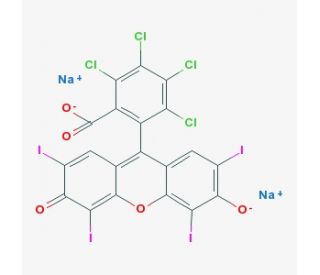

Molecular structure of Rose Bengal, CAS Number: 11121-48-5
Rose Bengal (CAS 11121-48-5)
Alternate Names:
4,5,6,7-Tetrachloro-2′,4′,5′,7′-tetraiodofluorescein disodium salt; Acid Red 94
Application:
Rose Bengal is a photosensitizer and dye
CAS Number:
11121-48-5
Molecular Weight:
1017.62
Molecular Formula:
C20H2Cl4I4O5•2Na
For Research Use Only. Not Intended for Diagnostic or Therapeutic Use.
* Refer to Certificate of Analysis for lot specific data.
QUICK LINKS
Ordering Information
Description
Technical Information
Safety Information
SDS & Certificate of Analysis
Rose Bengal is a stain used in a variety of applications such as in photosensitizing reactions and as a dye. Rose Bengal has been used as a photosensitizer in studies evaluating photodynamic susceptibility of planktonic cultures of Streptococcus mutans. Rose Bengal is additionally reported to act strongly on bacteria such as Staphylococcus aureus by reducing membrane potential after photo-irradiation. Rose Bengal is noted to be a derivative of Fluorescein (sc-206026) and is also available as Rose Bengal Sodium Salt (sc-203757).
Rose Bengal (CAS 11121-48-5) References
- Comparison of micro- and mesoporous inorganic materials in the uptake and release of the drug model fluorescein and its analogues. | Fisher, KA., et al. 2003. Chemistry. 9: 5873-8. PMID: 14673859
- Rose bengal and lissamine green inhibit detection of herpes simplex virus by PCR. | Seitzman, GD., et al. 2006. Am J Ophthalmol. 141: 756-8. PMID: 16564821
- In situ monitoring of photodynamic inactivation of the membrane functions of bacteria using electrochemical sensors. | Kato, H., et al. 2010. Anal Sci. 26: 1019-21. PMID: 20953042
- Structure Effect on Antioxidant Activity of Catecholamines toward Singlet Oxygen and Other Reactive Oxygen Species in vitro. | Shimizu, T., et al. 2010. J Clin Biochem Nutr. 47: 181-90. PMID: 21103026
- Susceptibility of planktonic cultures of Streptococcus mutans to photodynamic therapy with a light-emitting diode. | Costa, AC., et al. 2010. Braz Oral Res. 24: 413-8. PMID: 21180961
- Flow injection small-volume fiber-optic pH sensor based on evanescent wave excitation and fluorescence determination. | Xiong, Y., et al. 2011. J Fluoresc. 21: 1137-42. PMID: 21184258
- Photosensitized Cross-Linking of Tryptophan and Tyrosine Derivatives by Rose Bengal in Aqueous Solutions. | Ludvíková, L., et al. 2018. J Org Chem. 83: 10835-10844. PMID: 30085660
- Dark Antibacterial Activity of Rose Bengal. | Nakonechny, F., et al. 2019. Int J Mol Sci. 20: PMID: 31261890
- Photodynamic exposure of Rose-Bengal inhibits Tau aggregation and modulates cytoskeletal network in neuronal cells. | Dubey, T., et al. 2020. Sci Rep. 10: 12380. PMID: 32704015
- Effective photodynamic treatment of Trichophyton species with Rose Bengal. | Houang, J., et al. 2021. J Biophotonics. 14: e202000340. PMID: 33058451
- Efficacy of antimicrobial photodynamic therapy with Rose Bengal and blue light against cariogenic bacteria. | Hirose, M., et al. 2021. Arch Oral Biol. 122: 105024. PMID: 33352361
- Antibacterial Activity of Pharmaceutical-Grade Rose Bengal: An Application of a Synthetic Dye in Antibacterial Therapies. | Kurosu, M., et al. 2022. Molecules. 27: PMID: 35011554
- Rose bengal-modified gold nanorods for PTT/PDT antibacterial synergistic therapy. | Luo, X., et al. 2022. Photodiagnosis Photodyn Ther. 39: 102988. PMID: 35781095
- Interaction between rose bengal and different protein components. | Tseng, SC. and Zhang, SH. 1995. Cornea. 14: 427-35. PMID: 7545566
- A fiber-optic setup for quantification of root surface demineralization. | van der Veen, MH. and ten Bosch, JJ. 1996. Eur J Oral Sci. 104: 118-22. PMID: 8804899
Ordering Information
| Product Name | Catalog # | UNIT | Price | Qty | FAVORITES | |
Rose Bengal, 25 g | sc-296278 | 25 g | $82.00 | |||
Rose Bengal, 100 g | sc-296278A | 100 g | $214.00 | |||
Rose Bengal, 250 g | sc-296278B | 250 g | $423.00 |