
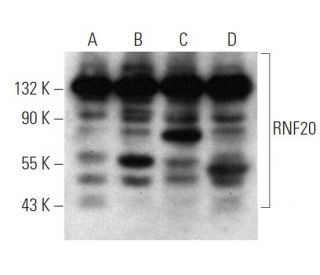

RNF20 Antibody (1594CT552.128.36): sc-517358
- RNF20 Antibody (1594CT552.128.36) is a mouse monoclonal IgG1 κ RNF20 antibody, cited in 3 publications, provided at 100 µg/ml
- raised against a recombinant protein corresponding to RNF20 of human origin
- recommended for detection of RNF20 of human origin by WBIP
- At present, we have not yet completed the identification of the preferred secondary detection reagent(s) for RNF20 Antibody (1594CT552.128.36). This work is in progress.

RNF20 Antibody (1594CT552.128.36) is a mouse monoclonal IgG1 kappa light chain antibody that detects RNF20 protein of human origin by western blotting (WB) and immunoprecipitation (IP). Anti-RNF20 antibody (1594CT552.128.36) is available as a non-conjugated format. RNF20, also known as ring finger protein 20, BRE1, BRE1A, or hBRE1, is a crucial 975 amino acid nuclear protein that plays a significant role in gene expression regulation through its function as an E3 ubiquitin-protein ligase. RNF20 is essential for histone H2B monoubiquitination, a modification vital for transcriptional activation of Hox genes. RNF20′s ability to facilitate this process underscores its importance in developmental biology and cellular differentiation. Additionally, RNF20 is recruited by tumor suppressor protein p53 to the MDM2 promoter, acting as a transcriptional co-activator, which highlights its potential role in cancer biology. Structurally, RNF20 contains a zinc finger domain and functions as a homodimer, which is critical for ligase activity and interaction with other proteins involved in the ubiquitination pathway. RNF20 serves as a key player in maintaining cellular homeostasis and regulating protein turnover, further emphasizing RNF20 (1594CT552.128.36) antibody′s relevance in research focused on gene regulation and cancer.
Alexa Fluor® is a trademark of Molecular Probes Inc., OR., USA
LI-COR® and Odyssey® are registered trademarks of LI-COR Biosciences
RNF20 Antibody (1594CT552.128.36) References:
- Monoubiquitination of human histone H2B: the factors involved and their roles in HOX gene regulation. | Zhu, B., et al. 2005. Mol Cell. 20: 601-11. PMID: 16307923
- The human homolog of yeast BRE1 functions as a transcriptional coactivator through direct activator interactions. | Kim, J., et al. 2005. Mol Cell. 20: 759-70. PMID: 16337599
- The histone H2B-specific ubiquitin ligase RNF20/hBRE1 acts as a putative tumor suppressor through selective regulation of gene expression. | Shema, E., et al. 2008. Genes Dev. 22: 2664-76. PMID: 18832071
- Menin and RNF20 recruitment is associated with dynamic histone modifications that regulate signal transducer and activator of transcription 1 (STAT1)-activated transcription of the interferon regulatory factor 1 gene (IRF1). | Buro, LJ., et al. 2010. Epigenetics Chromatin. 3: 16. PMID: 20825659
- WAC, a functional partner of RNF20/40, regulates histone H2B ubiquitination and gene transcription. | Zhang, F. and Yu, X. 2011. Mol Cell. 41: 384-97. PMID: 21329877
- Regulation of homologous recombination by RNF20-dependent H2B ubiquitination. | Nakamura, K., et al. 2011. Mol Cell. 41: 515-28. PMID: 21362548
- Resveratrol induces cellular senescence with attenuated mono-ubiquitination of histone H2B in glioma cells. | Gao, Z., et al. 2011. Biochem Biophys Res Commun. 407: 271-6. PMID: 21481687
- RNF20 inhibits TFIIS-facilitated transcriptional elongation to suppress pro-oncogenic gene expression. | Shema, E., et al. 2011. Mol Cell. 42: 477-88. PMID: 21596312
- A member of the ETS family, EHF, and the ATPase RUVBL1 inhibit p53-mediated apoptosis. | Taniue, K., et al. 2011. EMBO Rep. 12: 682-9. PMID: 21617703
Ordering Information
| Product Name | Catalog # | UNIT | Price | Qty | FAVORITES | |
RNF20 Antibody (1594CT552.128.36) | sc-517358 | 100 µg/ml | $322.00 |