
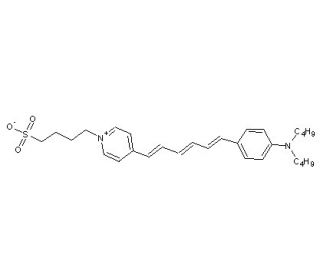

Molecular structure of RH 237
RH 237
See product citations (2)
Alternate Names:
N-(4-Sulfobutyl)-4-(6-(4-(dibutylamino)phenyl)hexatrienyl)pyridinium, inner salt
Molecular Weight:
496.70
For Research Use Only. Not Intended for Diagnostic or Therapeutic Use.
* Refer to Certificate of Analysis for lot specific data.
QUICK LINKS
Ordering Information
Product Citations
Description
Technical Information
Safety Information
SDS & Certificate of Analysis
RH 237 is a lipophilic cationic dye that is used as a fluorescent probe in biological research. It belongs to a class of compounds known as rhodamines, which are fluorescent dyes that are widely used in imaging applications due to their high brightness and photostability. RH 237 is particularly useful for imaging the activity of mitochondria, as it accumulates in the mitochondria and emits a bright red fluorescence when excited with a suitable light source. RH 237 has also been used in other applications, such as the measurement of transmembrane potential in cells and the imaging of neural activity.
RH 237 References
- Coherent scattering in multi-harmonic light microscopy. | Moreaux, L., et al. 2001. Biophys J. 80: 1568-74. PMID: 11222317
- Effects of electroporation on optically recorded transmembrane potential responses to high-intensity electrical shocks. | Nikolski, VP., et al. 2004. Am J Physiol Heart Circ Physiol. 286: H412-8. PMID: 14527941
- Probing amphotericin B single channel activity by membrane dipole modifiers. | Ostroumova, OS., et al. 2012. PLoS One. 7: e30261. PMID: 22276169
- The interaction of dipole modifiers with polyene-sterol complexes. | Ostroumova, OS., et al. 2012. PLoS One. 7: e45135. PMID: 23028805
- Expression of the sialyltransferase, ST3Gal4, impacts cardiac voltage-gated sodium channel activity, refractory period and ventricular conduction. | Ednie, AR., et al. 2013. J Mol Cell Cardiol. 59: 117-27. PMID: 23471032
- Mechanism of reentry induction by a 9-V battery in rabbit ventricles. | Bishop, MJ., et al. 2014. Am J Physiol Heart Circ Physiol. 306: H1041-53. PMID: 24464758
- Channel-forming activity of cecropins in lipid bilayers: effect of agents modifying the membrane dipole potential. | Efimova, SS., et al. 2014. Langmuir. 30: 7884-92. PMID: 24969512
- Visualization of epicardial cryoablation lesions using endogenous tissue fluorescence. | Swift, L., et al. 2014. Circ Arrhythm Electrophysiol. 7: 929-37. PMID: 25141861
- Membrane dipole modifiers modulate single-length nystatin channels via reducing elastic stress in the vicinity of the lipid mouth of a pore. | Chulkov, EG., et al. 2015. Biochim Biophys Acta. 1848: 192-9. PMID: 25223717
- Effects of Dipole Potential Modifiers on Heterogenic Lipid Bilayers. | Efimova, SS., et al. 2016. J Membr Biol. 249: 97-106. PMID: 26454655
- Long non-coding RNA CCRR controls cardiac conduction via regulating intercellular coupling. | Zhang, Y., et al. 2018. Nat Commun. 9: 4176. PMID: 30301979
- Optical second harmonic generation microscopy: application to the sensitive detection of cell membrane damage. | Kato, N. 2019. Biophys Rev. 11: 399-408. PMID: 31073956
- Prolonged ursodeoxycholic acid administration reduces acute ischaemia-induced arrhythmias in adult rat hearts. | Ferraro, E., et al. 2020. Sci Rep. 10: 15284. PMID: 32943714
Ordering Information
| Product Name | Catalog # | UNIT | Price | Qty | FAVORITES | |
RH 237, 5 mg | sc-499456 | 5 mg | $128.00 |