
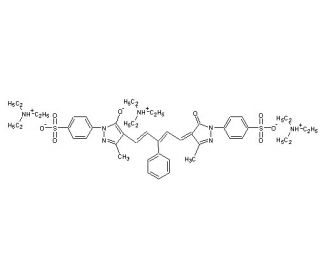

Molecular structure of RH 155, CAS Number: 254451-42-8
RH 155 (CAS 254451-42-8)
Alternate Names:
Neurodye RH-155
Application:
RH 155 is a colorimetric indicator for membrane potential
CAS Number:
254451-42-8
Molecular Weight:
950.26
Molecular Formula:
C49H71N7O8S2
For Research Use Only. Not Intended for Diagnostic or Therapeutic Use.
* Refer to Certificate of Analysis for lot specific data.
QUICK LINKS
Ordering Information
Description
Technical Information
Safety Information
SDS & Certificate of Analysis
RH 155 is a neuron-tracing dye. It is used for monitoring membrane potential, synaptic activity and ion channel activity of neurons. RH-155 has been utilized to examine the effects of L-DOPA on neuronal activity within the buccal ganglia of Aplysia, a model organism. The dye allows for the recording of changes in light absorbance that correlate with neuronal action potentials, offering high spatial and temporal resolution for observing the dynamic patterns of neuronal activity.
RH 155 (CAS 254451-42-8) References
- Multiple-site optical recording of mouse brainstem evoked by vestibulocochlear nerve stimulation. | Yang, S., et al. 2000. Brain Res. 877: 95-100. PMID: 10980249
- Dendritic origin of late events in optical recordings from salamander olfactory bulb. | Cinelli, AR. and Salzberg, BM. 1992. J Neurophysiol. 68: 786-806. PMID: 1432048
- Glutamate release increases during mossy-CA3 LTP but not during Schaffer-CA1 LTP. | Kawamura, Y., et al. 2004. Eur J Neurosci. 19: 1591-600. PMID: 15066155
- A stereo-compound hybrid microscope for combined intracellular and optical recording of invertebrate neural network activity. | Frost, WN., et al. 2007. J Neurosci Methods. 162: 148-54. PMID: 17306887
- Multiple site optical recording of transmembrane voltage (MSORTV), single-unit recordings, and evoked field potentials from the olfactory bulb of skate (Raja erinacea). | Cinelli, AR. and Salzberg, BM. 1990. J Neurophysiol. 64: 1767-90. PMID: 1981575
- Optogenetic interrogation of neural circuits: technology for probing mammalian brain structures. | Zhang, F., et al. 2010. Nat Protoc. 5: 439-56. PMID: 20203662
- [Simultaneously optical recording of membrane potential in population vestibular ganglion neurons]. | Yang, SM., et al. 2002. Zhongguo Ying Yong Sheng Li Xue Za Zhi. 18: 306-9. PMID: 21180079
- Influence of substrate on the distribution of calcium channels in identified leech neurons in culture. | Ross, WN., et al. 1988. Proc Natl Acad Sci U S A. 85: 4075-8. PMID: 2453887
- Unique Configurations of Compression and Truncation of Neuronal Activity Underlie l-DOPA-Induced Selection of Motor Patterns in Aplysia. | Neveu, CL., et al. 2017. eNeuro. 4: PMID: 29071298
- Optical recording of electrical activity from parallel fibres and other cell types in skate cerebellar slices in vitro. | Konnerth, A., et al. 1987. J Physiol. 393: 681-702. PMID: 3446807
- Enhanced fast synaptic transmission and a delayed depolarization induced by transient potassium current blockade in rat hippocampal slice as studied by optical recording. | Barish, ME., et al. 1996. J Neurosci. 16: 5672-87. PMID: 8795623
- Functional organization of rat olfactory bulb glomeruli revealed by optical imaging. | Keller, A., et al. 1998. J Neurosci. 18: 2602-12. PMID: 9502819
- Mapping membrane potential transients in crayfish (Procambarus clarkii) optic lobe neuropils with voltage-sensitive dyes. | Yagodin, S., et al. 1999. J Neurophysiol. 81: 334-44. PMID: 9914293
Ordering Information
| Product Name | Catalog # | UNIT | Price | Qty | FAVORITES | |
RH 155, 5 mg | sc-499432 | 5 mg | $474.00 |