
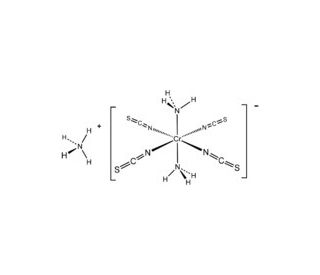

Reinecke salt (CAS 13573-16-5)
Veja citações de produtos (2)
LINKS RÁPIDOS
O sal de Reinecke, quimicamente conhecido como tetrafluoroborato de amónio, é um reagente crítico na química de coordenação e serve como uma ferramenta versátil na síntese e estudo de compostos complexos de coordenação de metais. Este sal é particularmente conhecido pela sua capacidade de formar complexos estáveis com metais de transição, que são essenciais para catalisar uma variedade de reacções químicas. No domínio da investigação, o sal de Reinecke é muito utilizado para precipitar e isolar alcalóides e outros compostos orgânicos azotados, o que lhe confere um valor inestimável nos processos de purificação dos laboratórios de síntese orgânica. As suas fortes propriedades de coordenação também permitem a sua utilização no estudo de estruturas moleculares e mecanismos de reação, fornecendo informações sobre os ambientes electrónicos dos centros metálicos e as suas interacções com outras moléculas. Esta aplicação é crucial para o desenvolvimento de novos materiais e catalisadores em aplicações industriais e ambientais, incluindo a síntese de produtos farmacêuticos e a limpeza de poluentes. Além disso, o sal de Reinecke tem sido utilizado em química analítica como agente cromogénico, onde é utilizado para desenvolver ensaios colorimétricos que detectam a presença de iões ou moléculas específicas, ajudando em análises quantitativas e qualitativas. Através destas aplicações variadas, o sal de Reinecke desempenha um papel significativo no avanço dos domínios da química e da ciência dos materiais.
Reinecke salt (CAS 13573-16-5) Referencias
- Aplicação do sal de Reinecke e da alizarina S na determinação da promazina. | Puzanowska-Tarasiewicz, H., et al. 2001. J Pharm Biomed Anal. 26: 1-5. PMID: 11451636
- Determinação colorimétrica e por AAS de cefalosporinas utilizando o sal de Reineck. | Salem, H. and Askal, H. 2002. J Pharm Biomed Anal. 29: 347-54. PMID: 12062696
- O efeito do beta-caroteno na fotoestabilidade da nisoldipina. | Mielcarek, J., et al. 2005. Methods Find Exp Clin Pharmacol. 27: 167-71. PMID: 15834448
- Fotoprotecção de derivados de 1,4-dihidropiridina por corantes. | Mielcarek, J., et al. 2005. Int J Pharm. 304: 145-51. PMID: 16188406
- Eléctrodos impressos no ecrã de NADH modificados com fosfato de zircónio, azul de Meldola e sal de Reinecke. Aplicação à deteção de glicerol por FIA. | Radoi, A., et al. 2007. Anal Bioanal Chem. 387: 1049-58. PMID: 17203252
- Estratégias para o desenvolvimento de detectores de NADH com base no azul de Meldola e em eléctrodos impressos por serigrafia: um estudo comparativo. | Vasilescu, A., et al. 2003. Talanta. 59: 751-65. PMID: 18968963
- Indigotina, azorubina e vermelho de cochonilha como fotoprotectores da manidipina. | Mielcarek, J., et al. 2010. Drug Dev Ind Pharm. 36: 302-6. PMID: 19663559
- Um sistema de injeção em fluxo, compreendendo um biossensor baseado num elétrodo de carbono impresso no ecrã contendo o sal de Meldola Blue-Reinecke revestido com glucose desidrogenase, para a medição da glucose. | Piano, M., et al. 2010. Anal Biochem. 396: 269-74. PMID: 19766585
- Reacções do resíduo de colina em sais de lecitina com sal de Reinecke e reagente de Roman. | Kurioka, S. 1968. J Biochem. 63: 675-7. PMID: 5723096
- Determinação espectrofotométrica do dimenidrinato com sal de Reinecke. | Kar, A. and Aniuha, GI. 1981. J Pharm Sci. 70: 690-1. PMID: 7252821
Informacoes sobre ordens
| Nome do Produto | Numero de Catalogo | UNID | Preco | Qde | FAVORITOS | |
Reinecke salt, 25 g | sc-203369 | 25 g | $164.00 | |||
Reinecke salt, 100 g | sc-203369A | 100 g | $492.00 |