
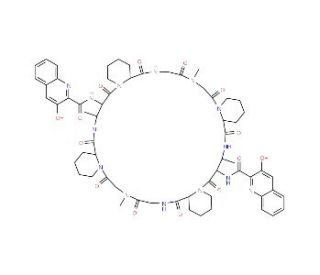

Quinaldopeptin (CAS 130743-07-6)
LINK RAPIDI
La quinaldopeptina è un composto depsipeptidico ciclico, inizialmente isolato dal batterio Streptomyces sp., noto per le sue caratteristiche strutturali distintive, tra cui una parte di acido quinaldico legata a un complesso anello peptidico. Funziona principalmente interferendo con l'RNA polimerasi batterica, un enzima chiave nel processo di trascrizione, inibendo così la sintesi di RNA. L'azione si esplica attraverso il legame con la subunità beta dell'RNA polimerasi, un'interazione che blocca efficacemente la via di trascrizione necessaria alla crescita e alla replicazione batterica. Nella ricerca, la quinaldopeptina è stata ampiamente utilizzata per studiare i meccanismi di inibizione della trascrizione, in particolare negli organismi procarioti. La sua modalità d'azione unica la rende uno strumento prezioso per sondare la struttura e la funzione dell'RNA polimerasi e per comprendere le implicazioni più ampie della regolazione trascrizionale nei batteri. Inoltre, lo studio della quinaldopeptina e delle sue interazioni ha contribuito al campo della fisiologia microbica evidenziando potenziali bersagli per lo sviluppo di nuovi inibitori in grado di interrompere specificamente i processi di trascrizione batterica. Questa ricerca è fondamentale per far progredire la conoscenza dei meccanismi di resistenza microbica e potrebbe aiutare a guidare la progettazione di nuovi composti per combattere i ceppi batterici resistenti, arricchendo così le strategie disponibili per il controllo delle infezioni batteriche.
Quinaldopeptin (CAS 130743-07-6) Referenze
- Struttura dell'esatiglato di actinotetraosio, un glucotetraosio unico di un batterio attinomicete. | Rickards, RW., et al. 1998. J Antibiot (Tokyo). 51: 1093-8. PMID: 10048568
- Prodotti naturali bisintercalatori con potenziali applicazioni terapeutiche: isolamento, determinazione della struttura, studi sintetici e biologici. | Dawson, S., et al. 2007. Nat Prod Rep. 24: 109-26. PMID: 17268609
- Quinaldopeptin, un nuovo antibiotico della famiglia delle chinomicine. | Toda, S., et al. 1990. J Antibiot (Tokyo). 43: 796-808. PMID: 2387774
- Sintesi totale della quinaldopeptina e dei suoi analoghi. | Ichikawa, S., et al. 2013. J Org Chem. 78: 12662-70. PMID: 24236405
- Sintesi e valutazione biologica della quinaldopeptina. | Katayama, K., et al. 2014. J Org Chem. 79: 2580-90. PMID: 24555872
- Kribbellichelins A e B, due nuovi antibiotici da Kribbella sp. CA-293567 con attività contro diversi patogeni umani. | Virués-Segovia, JR., et al. 2022. Molecules. 27: PMID: 36234892
- Introduzione di nuovi target farmacologici contro lo Staphylococcus aureus e proposta di inibitori putativi contro l'Adenina N1 (m1A22)-tRNA metiltransferasi (TrmK) mediante la scoperta farmacologica assistita da computer. | Beig, M., et al. 2023. Curr Pharm Des. 29: 1135-1147. PMID: 37132149
- Analisi strutturale e funzionale della proteina Ecm16 di Streptomyces lasalocidi che conferisce resistenza all'echinomicina. | Gade, P., et al. 2023. Sci Rep. 13: 7980. PMID: 37198233
- Relazioni struttura-attività di peptidi bis-intercalanti e loro applicazione come payload di coniugati anticorpo-farmaco. | Petersen, ME., et al. 2023. J Med Chem. 66: 8288-8309. PMID: 37307297
- Caratterizzazione della struttura cristallina, analisi dell'energia di interazione e studi DFT della 3-(4-clorofenil)-N-fenilchinossalina-2-ammina | Akhileshwari, P., et al. 2023. Journal of Chemical Crystallography. 53(2): 185-196.
Informazioni ordini
| Nome del prodotto | Codice del prodotto | UNITÀ | Prezzo | Quantità | Preferiti | |
Quinaldopeptin, 500 µg | sc-202304 | 500 µg | $440.00 |