
Date published: 2026-5-5

1-800-457-3801

SCBT Portrait Logo
Seach Input

PTPµ Antibody (SBK10): sc-65228

5.0(3)
Write a reviewAsk a question

Datasheets
  • PTPµ Antibody (SBK10) is a mouse monoclonal IgG1 κ PTPµ antibody, cited in 2 publications, provided at 200 µg/ml
  • raised against amino acids 42-60 of PTPμ of human origin
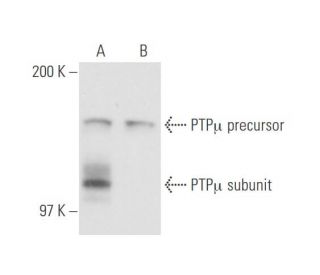
  • recommended for detection of PTPµ of mouse, rat and human origin by WB and IP; also reactive with additional species, including bovine
  • m-IgG Fc BP-HRP and m-IgG1 BP-HRP are the preferred secondary detection reagents for PTPµ Antibody (SBK10) for WB applications. These reagents are now offered in bundles with PTPµ Antibody (SBK10) (see ordering information below).
Gene Editing Promo Banner

QUICK LINKS

SEE ALSO...

PTPµ Antibody (SBK10) is a mouse monoclonal IgG1 kappa light chain antibody that detects PTPμ protein of mouse, rat, and human origin by western blotting (WB) and immunoprecipitation (IP). Anti-PTPμ antibody (SBK10) is available as the non-conjugated format. PTPμ protein is a member of the protein tyrosine phosphatase family, which plays a crucial role in cellular signaling by dephosphorylating tyrosine residues on proteins, thereby regulating various cellular processes such as growth, differentiation, and metabolism. PTPμ is a type I transmembrane protein primarily localized at cell-cell contact points, where PTPμ is involved in the assembly and disassembly of cadherin/catenin complexes, essential for maintaining cell adhesion and tissue integrity. Such localization is particularly important in development and tissue homeostasis, helping regulate interactions between neighboring cells. Dysregulation of PTPμ has been implicated in various pathological conditions, including cancer, making PTPμ a significant target for research in understanding tumor biology and potential therapeutic interventions.

For Research Use Only. Not Intended for Diagnostic or Therapeutic Use.

Alexa Fluor® is a trademark of Molecular Probes Inc., OR., USA

LI-COR® and Odyssey® are registered trademarks of LI-COR Biosciences

PTPµ Antibody (SBK10) References:

  1. Protein kinase C delta (PKCdelta) is required for protein tyrosine phosphatase mu (PTPmu)-dependent neurite outgrowth.  |  Rosdahl, JA., et al. 2002. Mol Cell Neurosci. 19: 292-306. PMID: 11860281
  2. Receptor protein tyrosine phosphatase mu expression as a marker for endothelial cell heterogeneity; analysis of RPTPmu gene expression using LacZ knock-in mice.  |  Koop, EA., et al. 2003. Int J Dev Biol. 47: 345-54. PMID: 12895029
  3. Caveolin-1 is transiently dephosphorylated by shear stress-activated protein tyrosine phosphatase mu.  |  Shin, J., et al. 2006. Biochem Biophys Res Commun. 339: 737-41. PMID: 16325778
  4. Identification of phospholipase C gamma1 as a protein tyrosine phosphatase mu substrate that regulates cell migration.  |  Phillips-Mason, PJ., et al. 2011. J Cell Biochem. 112: 39-48. PMID: 20506511
  5. Diverse injurious stimuli reduce protein tyrosine phosphatase-μ expression and enhance epidermal growth factor receptor signaling in human airway epithelia.  |  Hyun, SW., et al. 2011. Exp Lung Res. 37: 327-43. PMID: 21649524
  6. Complex-type asparagine-linked oligosaccharides on phosphacan and protein-tyrosine phosphatase-zeta/beta mediate their binding to neural cell adhesion molecules and tenascin.  |  Milev, P., et al. 1995. J Biol Chem. 270: 24650-3. PMID: 7559574
  7. Protein-tyrosine phosphatase epsilon. An isoform specifically expressed in mouse mammary tumors initiated by v-Ha-ras OR neu.  |  Elson, A. and Leder, P. 1995. J Biol Chem. 270: 26116-22. PMID: 7592814
  8. Receptor protein tyrosine phosphatase PTPmu associates with cadherins and catenins in vivo.  |  Brady-Kalnay, SM., et al. 1995. J Cell Biol. 130: 977-86. PMID: 7642713
  9. Increased abundance of the receptor-type protein-tyrosine phosphatase LAR accounts for the elevated insulin receptor dephosphorylating activity in adipose tissue of obese human subjects.  |  Ahmad, F., et al. 1995. J Clin Invest. 95: 2806-12. PMID: 7769120
  10. Homophilic interactions mediated by receptor tyrosine phosphatases mu and kappa. A critical role for the novel extracellular MAM domain.  |  Zondag, GC., et al. 1995. J Biol Chem. 270: 14247-50. PMID: 7782276
  11. Stimulation of receptor protein-tyrosine phosphatase alpha activity and phosphorylation by phorbol ester.  |  den Hertog, J., et al. 1995. Cell Growth Differ. 6: 303-7. PMID: 7794797
  12. Increased proteolytic processing of protein tyrosine phosphatase mu in confluent vascular endothelial cells: the role of PC5, a member of the subtilisin family.  |  Campan, M., et al. 1996. Biochemistry. 35: 3797-802. PMID: 8620001

Ordering Information

Product NameCatalog #UNITPriceQtyFAVORITES

PTPµ Antibody (SBK10)

sc-65228
200 µg/ml
$322.00

PTPµ Antibody (SBK10): m-IgG Fc BP-HRP Bundle

sc-539158
200 µg Ab; 10 µg BP
$361.00

PTPµ Antibody (SBK10): m-IgG1 BP-HRP Bundle

sc-541300
200 µg Ab; 20 µg BP
$361.00

For Western Blot, is it recommended to use denatured or non-denatured conditions with PTPμ (SBK10): sc-65228 monoclonal antibody?

Asked by: TinTin
Thank you for your question. We recommend this antibody for use in denatured Western Blot conditions. It has not been validated for use in non-denatured conditions. Please contact our Technical Service Department for further details or inquiries.
Answered by: Technical Support
Date published: 2017-02-27
  • y_2026, m_4, d_29, h_11CST
  • bvseo_bulk, prod_bvqa, vn_bulk_3.0.43
  • cp_1, bvpage1
  • co_hasquestionsanswers, tq_1
  • loc_en_US, sid_65228, prod, sort_[SortEntry(order=LAST_APPROVED_ANSWER_SUBMISSION_TIME, direction=DESCENDING)]
  • clientName_scbt
  • bvseo_sdk, java_sdk, bvseo-4.0.0
  • CLOUD, getContent, 110ms
  • QUESTIONS, PRODUCT
Rated 5 out of 5 by from Positive band obtained in WB in SKPositive band obtained in WB in SK-N-SH and T98G whole cell lysates. -SCBT QC
Date published: 2015-03-05
Rated 5 out of 5 by from Published data for IP and WB in mouse andPublished data for IP and WB in mouse and rat cariomyocytes. -SCBT Publication Review
Date published: 2015-01-03
Rated 5 out of 5 by from Published IP and WB data with mouse and ratPublished IP and WB data with mouse and rat heart and cardiomyocytes - SCBT Publication Review
Date published: 2014-09-12
  • y_2026, m_4, d_29, h_11
  • bvseo_bulk, prod_bvrr, vn_bulk_3.0.43
  • cp_1, bvpage1
  • co_hasreviews, tv_0, tr_3
  • loc_en_US, sid_65228, prod, sort_[SortEntry(order=SUBMISSION_TIME, direction=DESCENDING)]
  • clientName_scbt
  • bvseo_sdk, java_sdk, bvseo-4.0.0
  • CLOUD, getReviews, 16ms
  • REVIEWS, PRODUCT
PTPµ Antibody (SBK10) is rated 5.0 out of 5 by 3.
  • y_2026, m_4, d_29, h_11
  • bvseo_bulk, prod_bvrr, vn_bulk_3.0.43
  • cp_1, bvpage1
  • co_hasreviews, tv_0, tr_3
  • loc_en_US, sid_65228, prod, sort_[SortEntry(order=SUBMISSION_TIME, direction=DESCENDING)]
  • clientName_scbt
  • bvseo_sdk, java_sdk, bvseo-4.0.0
  • CLOUD, getAggregateRating, 106ms
  • REVIEWS, PRODUCT
